
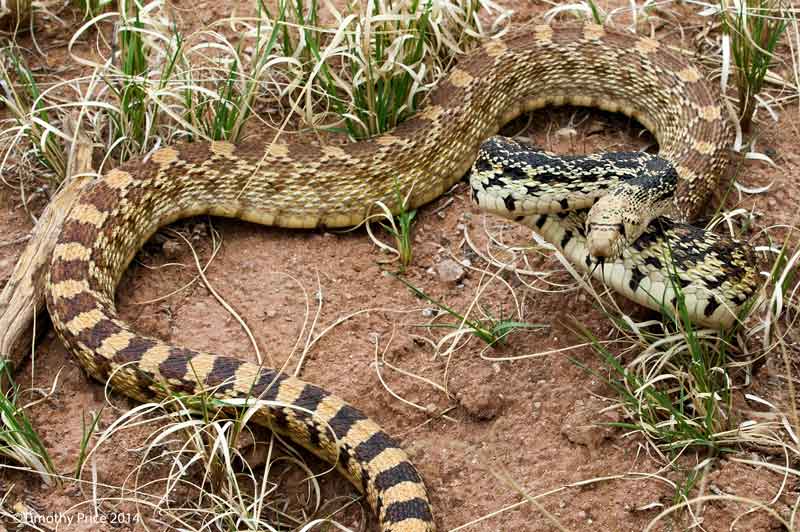
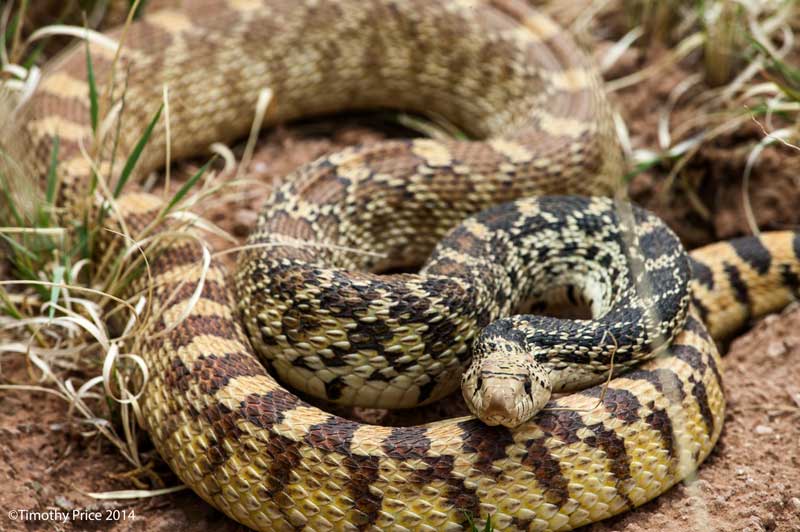
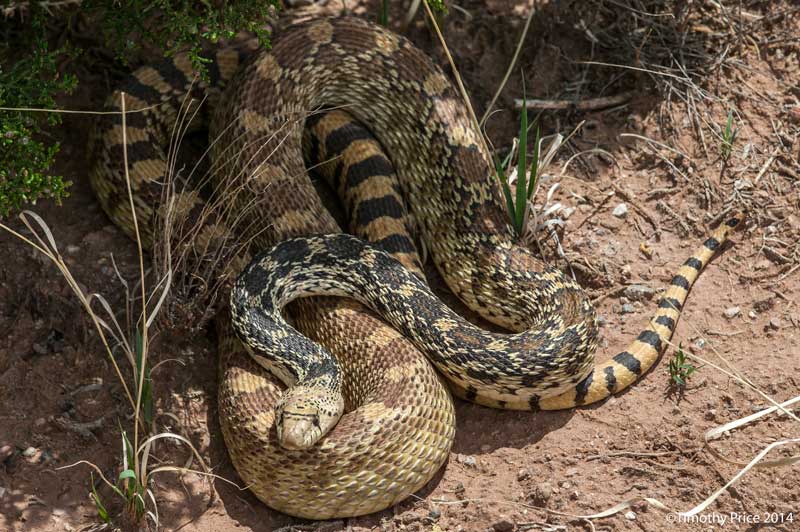
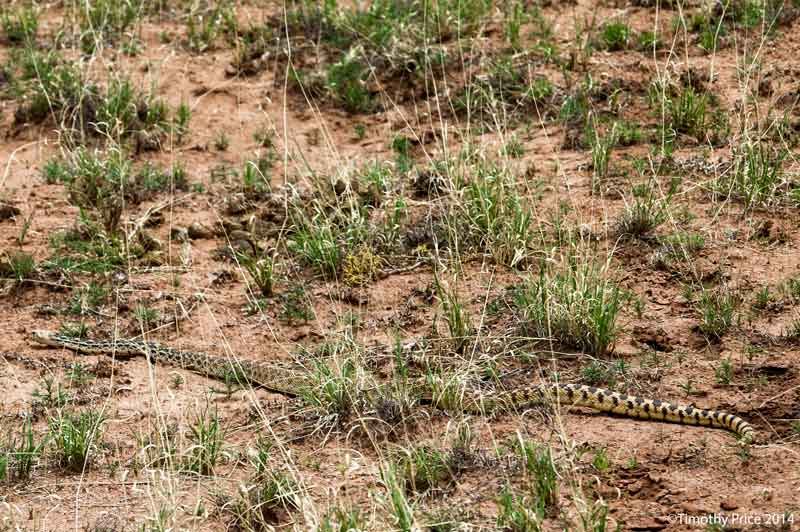
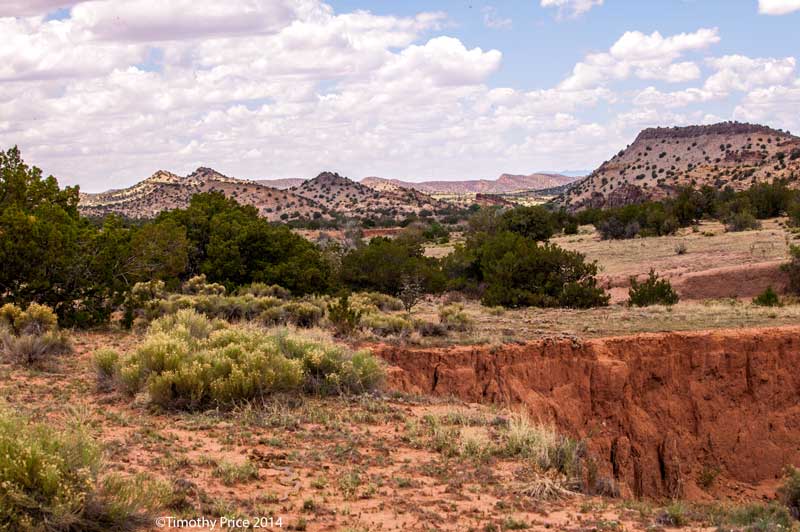
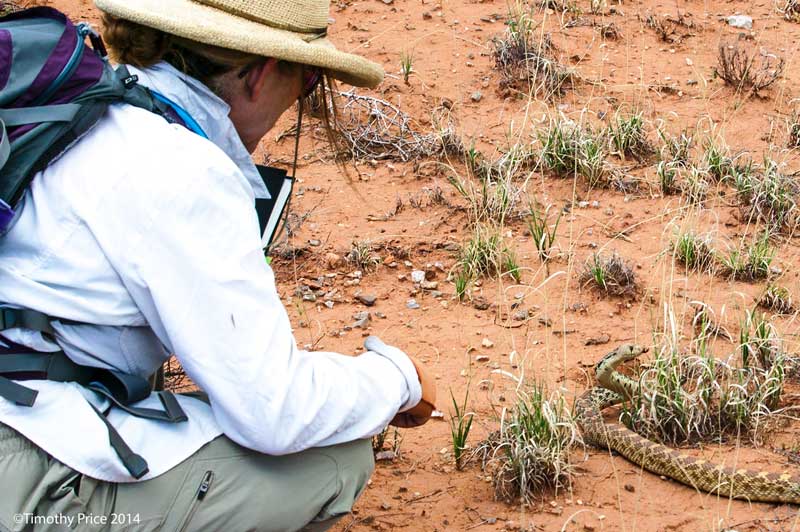
While I was sitting on a rock in the canyon at Desert Harbor Retreat looking at the landscape, watching the birds in the distance, and observing the various insects crawling around my feet, this large bull snake (about six feet long) crawled by just a few feet away. He got defensive when I got close with the camera, but then he settled down and let me get to within less than an inch of him with the camera’s lens.
If you don’t know your snakes, you might confuse this bullsnake with a rattlesnake. The markings are similar to a rattlesnake’s, and with his defensive postures, he mimics a rattlesnake by raising his body into a striking position; he flattens his head to make it more triangular, hisses, and vibrates his tail like a rattlesnake (if there are dried leaves to vibrate his tail against, he will sound somewhat like a rattlesnake). But that’s where the similarities end. A bullsnake is slender, and has a thin, round head compared to a rattlesnake. Bullsnakes are non-venomous constrictors, with round pupils. A Western Diamondback rattlesnake the same length as this bullsnake would have a girth at least four times larger, and its head would be three or four times larger than the bullsnake’s head. Rattlesnakes have raised plates over their cat-like eyes, triangular heads, and pits on the sides of their faces (you can see a Western Diamondback rattlesnake in my blog from July 2, 2013).
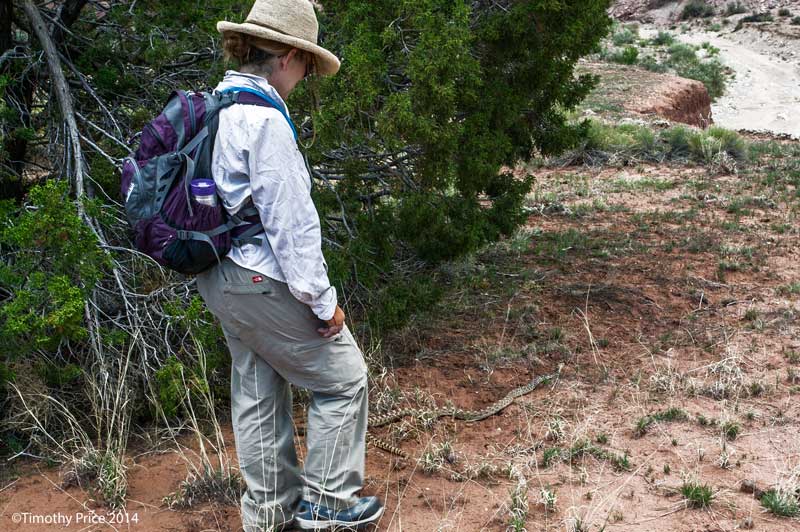
After a while, the bullsnake decided we were no longer a threat and continued his hunting. We followed him around, observing him for about 45 minutes as he seemed to be following a scent trail. We walked beside him, behind him, observed him closely, and he simply went about his business as if we were not even there. I was thinking that he might flush out a field mouse, grab it, constrict it, then eat it, and I could document the hunt, the kill and the meal, but he was still hunting when we parted ways.





 Off Center & Not Even
Best defense – stay clear. 👍
Especially if you are not sure. Of course, I love snakes and will observe them where ever I see them.
Fascinating!
Thanks!
He has such varied colorations~
Helps him camouflage.
That is a beautiful snake! Great photos of him! I also liked your story of Button the Rattle Snake. Also a gorgeous snake. My father had a pet rattler for a while when he was a boy.
I see what you mean about the differences in the way the rattle snakes heads are structured compared to the bull snake, although coloration is similar. We have bull snakes here too I am told, although what we see most often are gopher snakes, if I am identifying them correctly.
Pine, gopher and bull snakes are all very similar. I’m not sure I could really tell you the differences. They have subtle differences in pattern, coloring, but in the wild I believe their food preferences are what distinguish them the most.
Amazing photographs! Guess I would just run away with my camera…
Thanks! You just need a good telephoto lens if you don’t what to be in striking distance.
What a fabulous little photo story!!!! LOVE it and such a beautiful snake â good of you to educate the difference from the scary cousin!! Where is Desert Harbor?â¦I expect a lakeside marina with a nice bar and grillâ¦sunsets and water oasis in the desertâ¦bet youâre going to tell me differently.
Go back a couple of blogs and you’ll learn about Desert Harbor.
He’s such a cute snake!!!
Sorry but I can’t say that I love as cats… 🙂 But great photographs. Thank you, love, nia
I can’t say snakes do it for me, but a great set of pics I must say.
Thanks!
Reblogged this on rebloggobbler.
Excellent post and images Timothy! We had many of these roaming on our property in the east mountains. Your synopsis here is perfect! We especially liked them around as we are gardeners and without these aides we would succumb to gophers!
Thanks! Bullsnakes are quite good at eating gophers and other pesky rodents. We see far fewer of them in Corrales than we used to with the increased development and traffic.
Well now that you mentioned it the bullsnakes in the east mountains, over a 7 year period, all but vanished from our property. Clearly something changed and we suspected development.
I’d be screaming!!!!!!! Petrified of snakes:)
Sorry to hear that!
That is one scaly snake!
Snakes in hot, dry environments have larger, thicker, more pronounced scales than snakes in more humid environments. My Red Tailed Boa Constrictor (found in South and Central America) has super smooth and supple scales compared to bullsnakes and rattlesnakes we see out here.
That makes sense. It’s just like our skin.
What an adventure! I would have run the other way… haha!! Glad you enjoyed the experience.