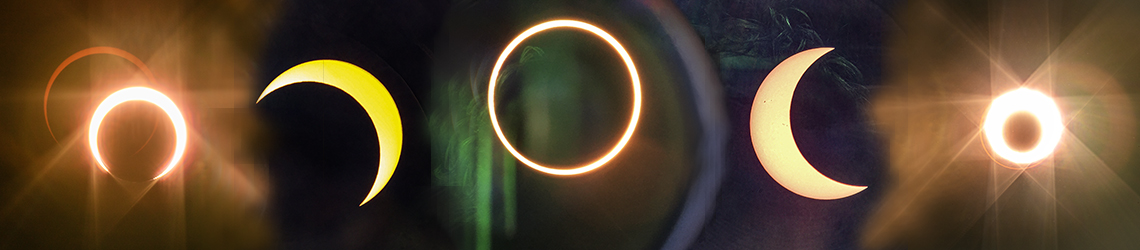

Sunrise


I’ve been working on Tristan’s house preparing to put it on the market. I finished painting the living room today. I had my moments with the high ceiling.
Sunrise
I’ve been working on Tristan’s house preparing to put it on the market. I finished painting the living room today. I had my moments with the high ceiling.
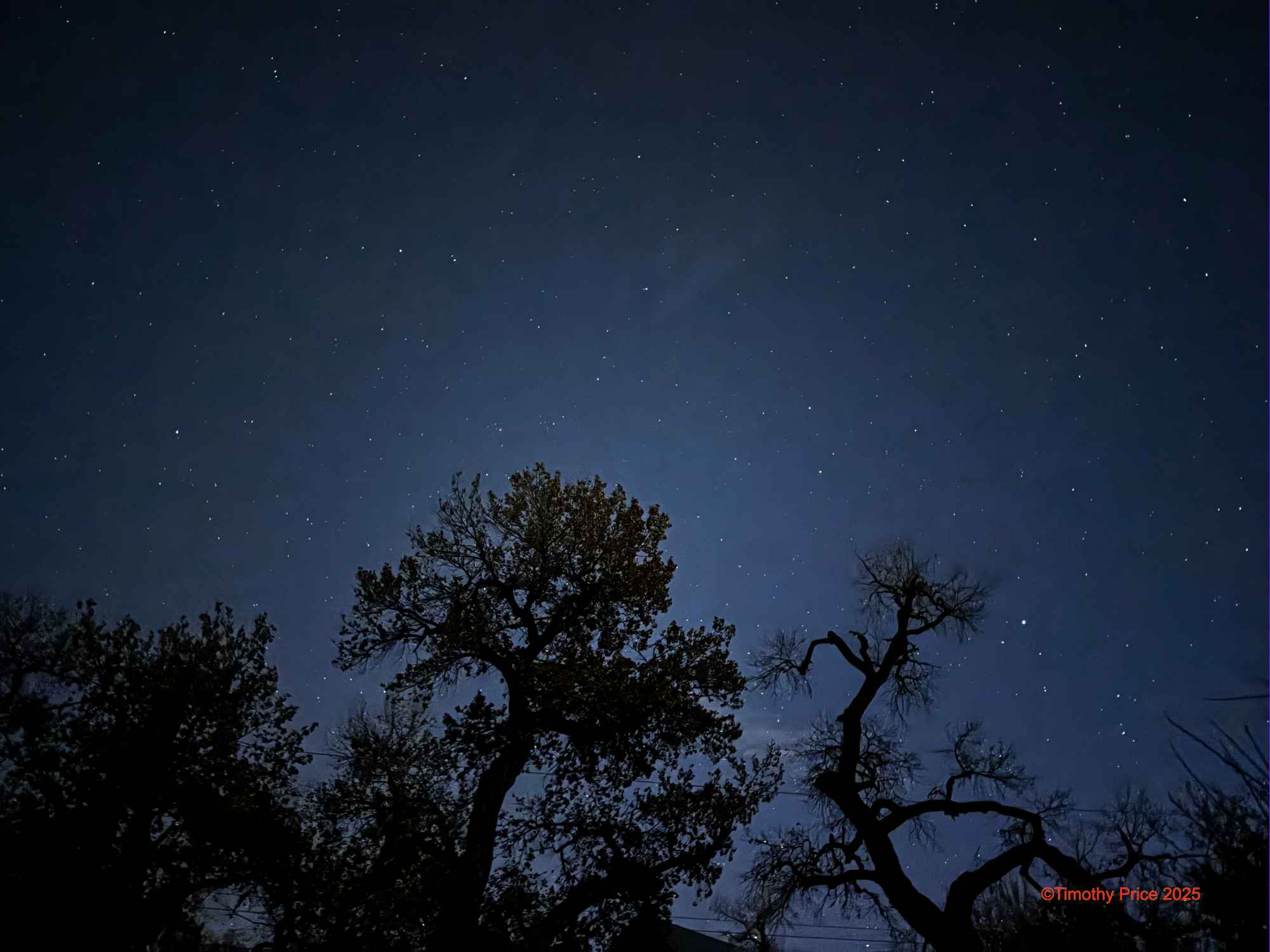
Early morning stars in the northern sky
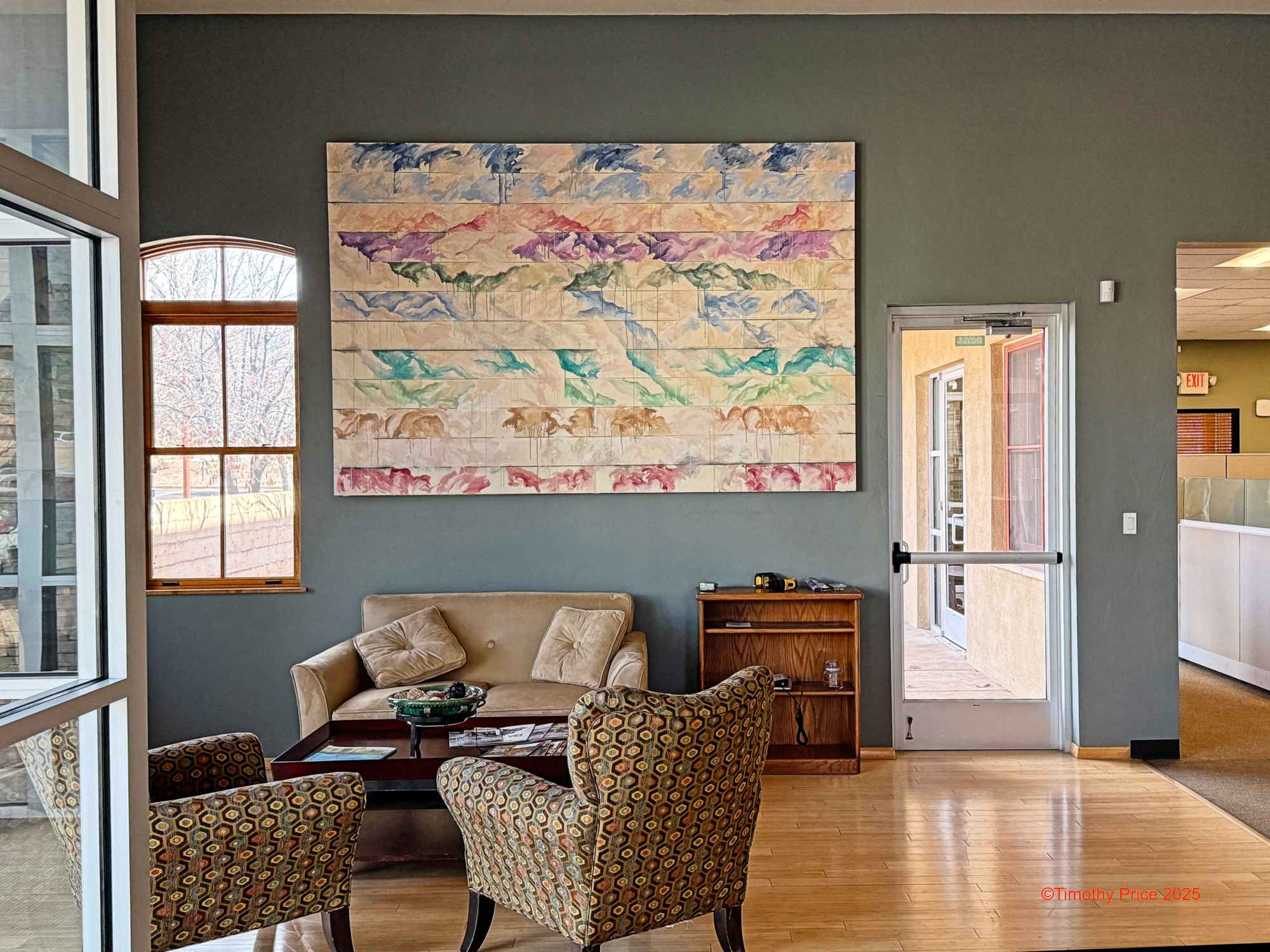
On their second day at work, our two new staff members had the exciting task of helping me hang Laurie’s 6×9 foot (183×274 centimeter) painting. There were five staff members involved in the effort. I used L-brackets to secure it on the wall.
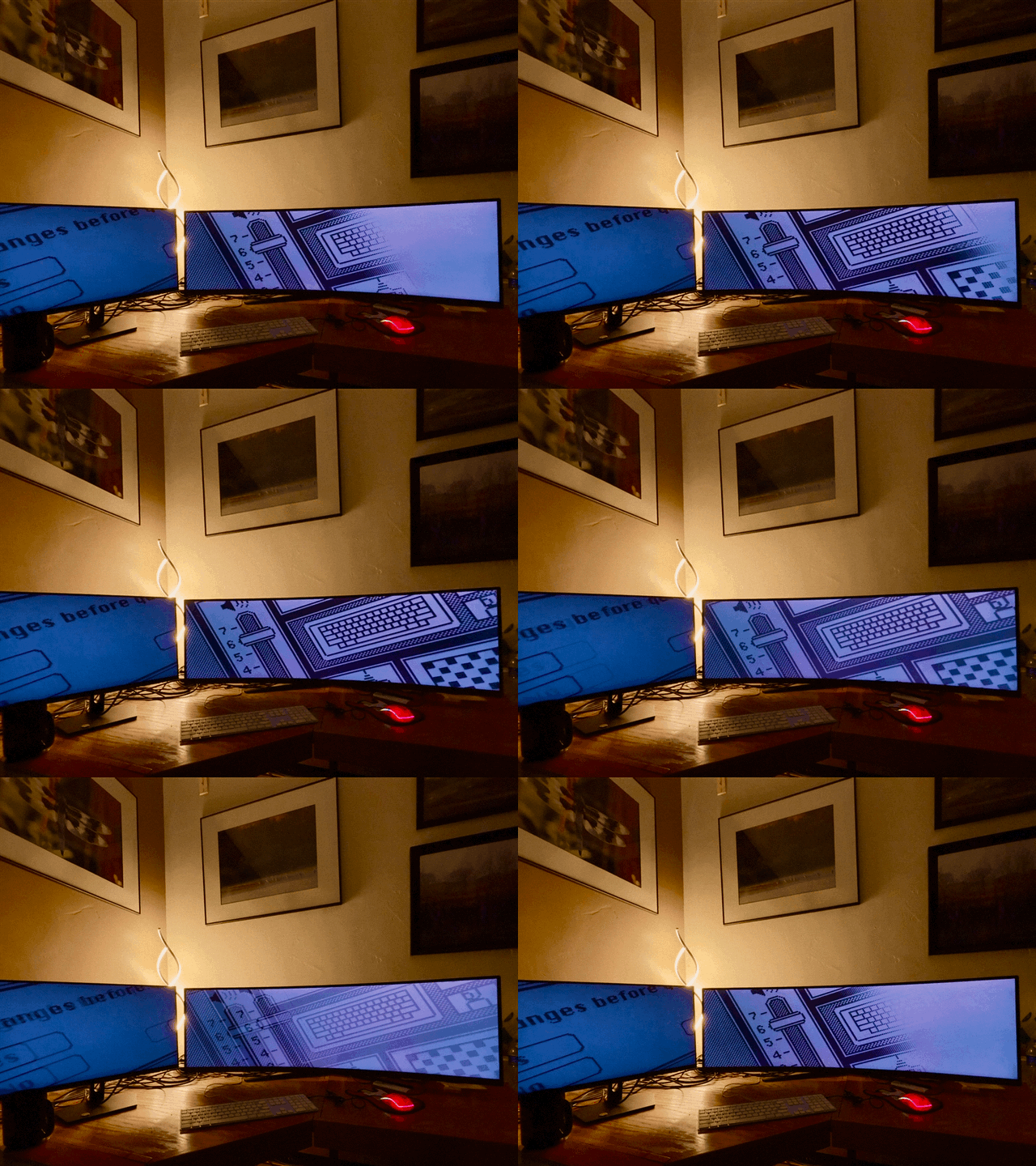
I also inherited the 40-inch (101.6 cm) screen on the right from Tristan because she didn’t want to ship it to Germany. I really spread out my spreadsheets on that screen.
I’m so excited and honored that my poem A Walk In Winter was featured on MasticadoresUsa // Editora: Gabriela Marie Milton today. Thank you, Gabriela!
Criag, who is a member of Tristan’s Tribe, recorded a wonderful unplugged cover of I Sat By The Ocean. Tristan painted a watercolor for the song.

Watercolor by Tristan Price.
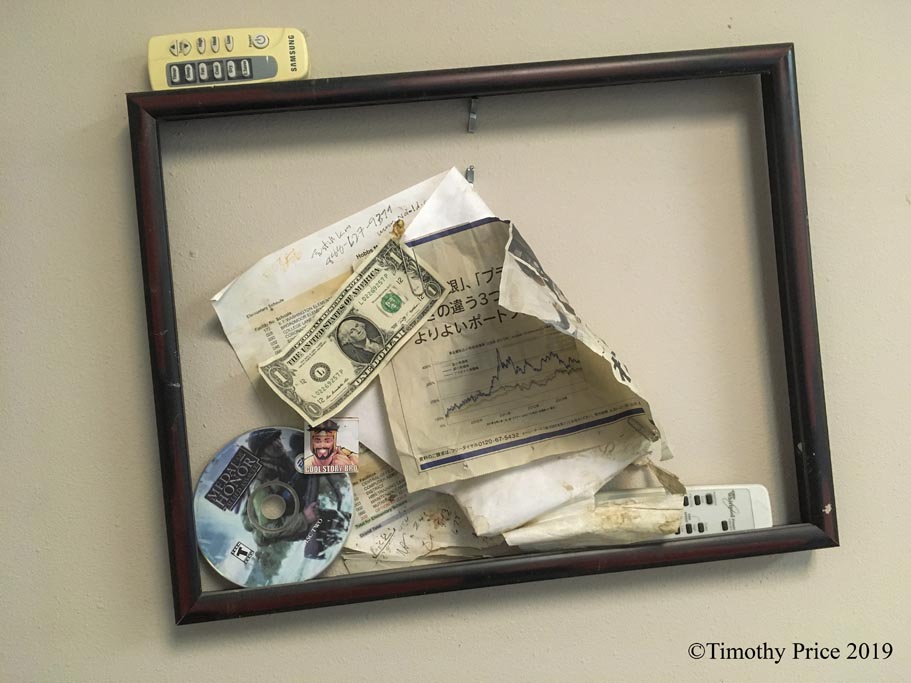
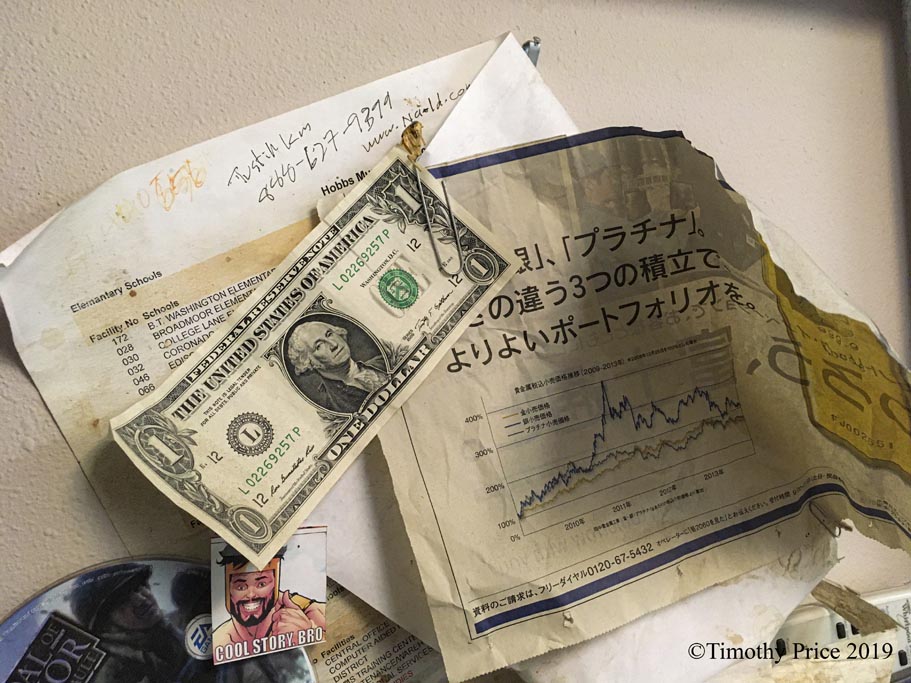
The Haphazard Homemaker’s post 10 Minute Picture Frame Wreath reminded me of my first post But Is It Art? that I had done when I first started this art piece in 2014 with two compnents: the print of the spreadsheet and the dollar bill donated by Sean, a computer wizard who owns EDI Systems. Staff and clients have contributed found objects to the piece since then. I added the frame around October or November of 2014, along with a couple of mummified cockroaches from my Cucaracha Crunch Coffee, and Cucaracha Crunch Blonde Coffee.
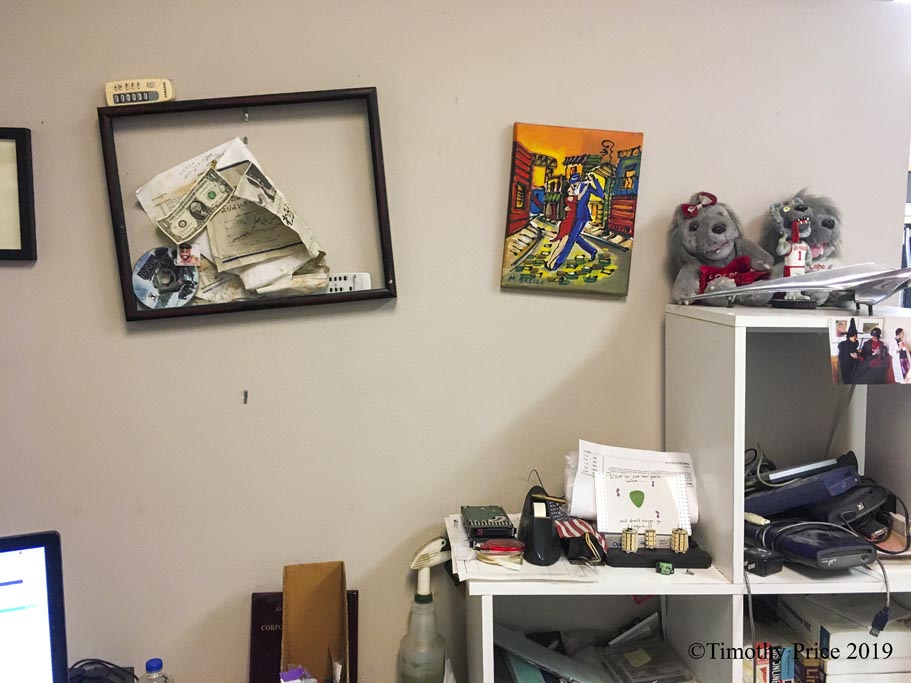
The wider scene of the wall the piece hangs on in my office includes a painting from Brazil a former staff member gave me, our UNM Lobo mascots collection (Lobo Lucie and Lobo Louie), a 1959 Ford Fairlane hood ornament another former staff member gave me, various vintage zip drives, and a framed guitar pick I extracted from the DVD drive that was in yet another former staff member’s laptop. I had to completely disassemble her laptop to get to the DVD drive to extract the pick. It was a very involved process. When I asked how the pick got in the drive, all she said was “Boonesfarm Strawberry Hill wine was involved!”
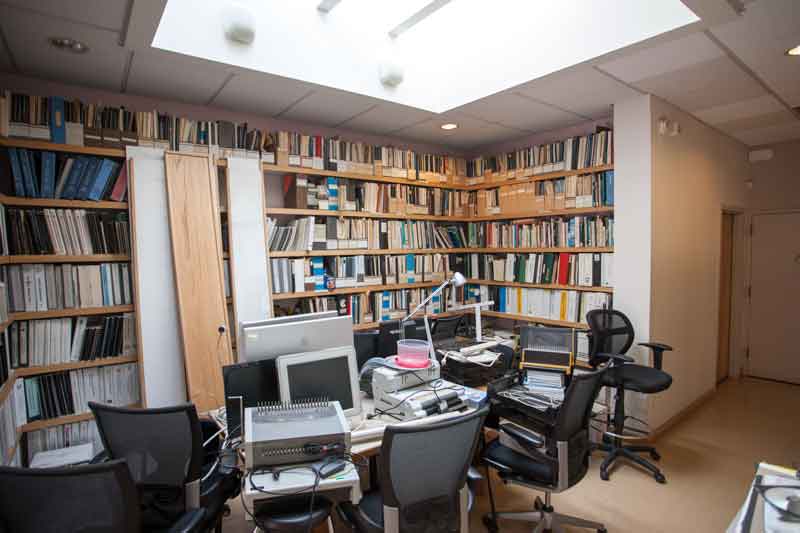
One of the advantages to closing the office between Christmas and New Years is I can do things like have the office painted without disrupting and displacing staff. The disadvantage is I don’t get much of a Christmas break. The last time the office was painted was 1995…
See and read more at: http://photos.tandlphotos.com/blog/2016/12/what-i-did-on-my-christmas-break
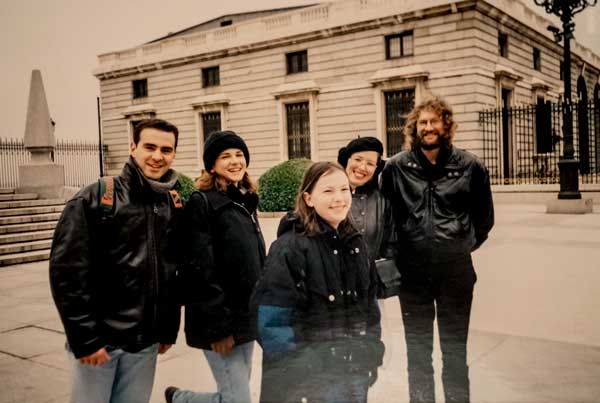
As I move from flamenco shows and the music scene to cover other areas of Madrid, I’m starting with my initial reactions to, and brief descriptions of, the Natural History Museum, Archaeology Museum and the Prado. We visited the Prado almost weekly and other art museums often. Most museums had free days, and we would go to those museums over and over on free days, so in future letters I will have more detailed descriptions of museums and exhibits.
April 18, 1996
Museums
We visited the natural history museum a few weeks back. It is pretty lame compared to what we have in Albuquerque. The first part of it is more of a history of natural science from the time when Carlos III dedicated the museum. The exhibits on this side of the building have animal specimens that are stuffed, mounted, dried, and bottled. There are books, notes, and letters about scientific principles, ideas, theories, and observations, along with examples of the tools and instruments used at the time. This stuff was fairly interesting. The rest of the exhibits on the north side of the building dealt with conservation and was not particularly new or interesting. We were about to suffocate in the enviro-better-feel-guilty-about-being-a-human theme when we made our escape over to the south side of the building where they had dinosaur bones, geologic and paleontologic exhibits. These we better, but still generally lame. The most interesting fossil was one of a dinosaur bird found in Spain. They had the fossil and a model of the bird. It was about the size of a robin with a beak full of teeth. All the other fossils were replicas of fossils and skeletons of dinosaurs that came from the U.S. and Argentina, of course. The exhibit on prehistoric man was good, which I would expect, since a lot of the remains of Neanderthals, Habilis, Erectus, and other early humans have been found in Spain. I think there are a few direct decedents of early man still walking the streets around here.
There is an excellent Archaeology Museum and a very good museum about the history of Madrid very near where we live. Spain has a great deal of historical treasures and just about every major civilization has been through and occupied Spain at one time or another. These museums are full of priceless artifacts and art works from prehistoric times through more recent times. There are also great art museums such as the Prado, the Reina Sofia and the Thyssen, plus a multitude of small art museums.
We go to the Prado almost every week end. It’s a good thing we looked at Goya’s paintings at the Prado the first few times we went. There is now a commemorative exhibit of his paintings celebrating 250 years since his birth that costs 1000 ptas/person to see, and the lines to get in are long. His black paintings done later in Goya’s life are interesting. These paintings are dark, loosely painted and powerful. They’re very expressionist and deal with mythology, religion, and war. There is one very modern painting of a dog buried up to his neck with the background painted like a sand dune. We also found the Bosch paintings. I figured Tristan would like Bosch since his paintings are so weird, with fantasy characters, landscapes and strange objects. Bosch was very disturbed from looking at his paintings. He has fantastic creatures, characters and scenes, that are full of action and layers of demented symbolism depicting the creation, earthly existence and hell. His explicit, lewd subject matter depicts a world view of the religious sect he belonged to. Nudity and sexual freedom are true to the creation, while marriage and clothing corrupt man and lead him to war and hell. Interesting world view for the 1600’s. Peter Brueghal the Elder depicted war as death winning. He also shows a very dim and demented view of life and grim depiction of war about 40 years after Bosch. Death’s army of skeletons are killing everyone, herding them into a coffin like structure that outputs more skeletons to join the war against humanity. Cities are on fire, men are hung on torture wheels, nailed through the head to trees and are being executed by skeletons. Death gets little resistance as his army sweeps over the land killing everything that lives. I’m glad not to have lived during the 1600’s, from these painters’ depictions of life.
Next architecture and planning…
Videos
Exposición: Goya en Madrid https://www.youtube.com/watch?v=PQi4O3fL1dk (English subtitles)
Hieronymus Bosch – Trittico del Giardino delle Delizie (spiegato ai truzzi) https://www.youtube.com/watch?v=DbXDmcVnAl8 (narration in Italian)
The Triumph of Death – Pieter Bruegel The Elder https://www.youtube.com/watch?v=kjhLgI3WsX8

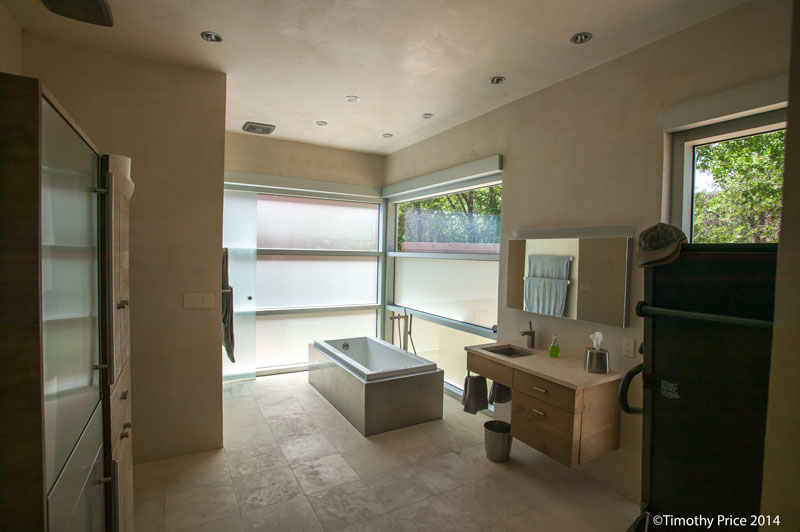
“This integral arrangement — minimalist home of rammed earth walls, plus native grasses — works perfectly as a unit.” reads the introduction to the writeup on the Roger and Mary Downey Garden for the Corrales Garden Tour we went on last weekend. The house sits in the center of the property surrounded by native grasses. Since this is only late spring, the grasses are just starting to grow. The grasses are best seen in the fall when they have reached their full heights and display their varied colors — colors that are reflected in the rammed earth construction of the house.




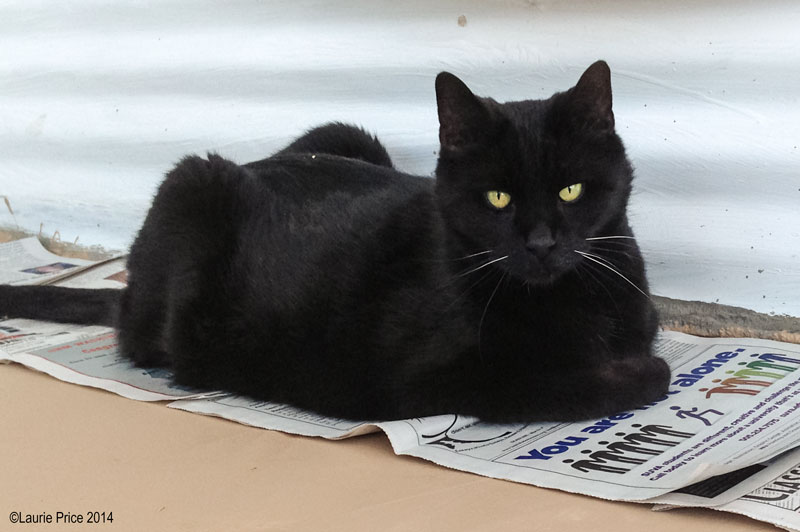
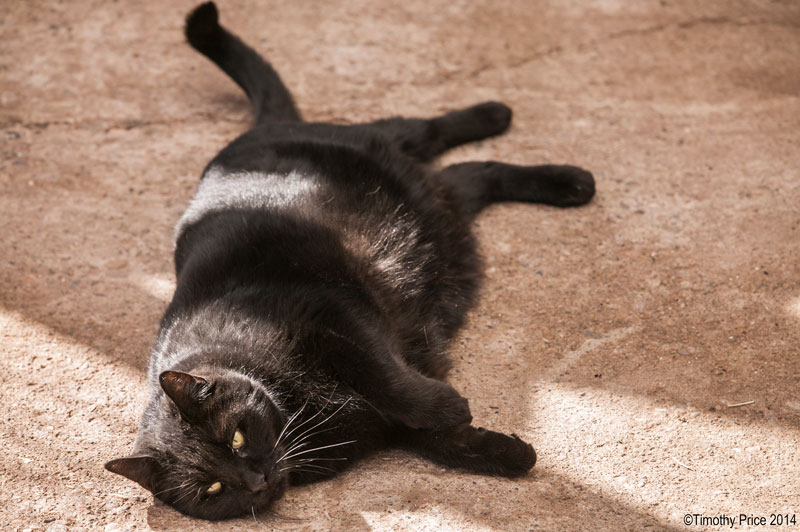
Guildenstern was pointing out the obvious while Laurie was painting the catio. Rosencrantz wasn’t so sure about the obvious.

Work continues on the catio. We started preparing the old cement slab for resurfacing on Saturday, but then we discovered we needed to rent a high pressure sprayer to clean it before we put on the resurfacing cement, plus the temperatures are supposed to stay above 50º F for 8 hours after the new surface is applied. Since the temperature only got into the 40’s over the weekend we decided to prepare surfaces for painting.
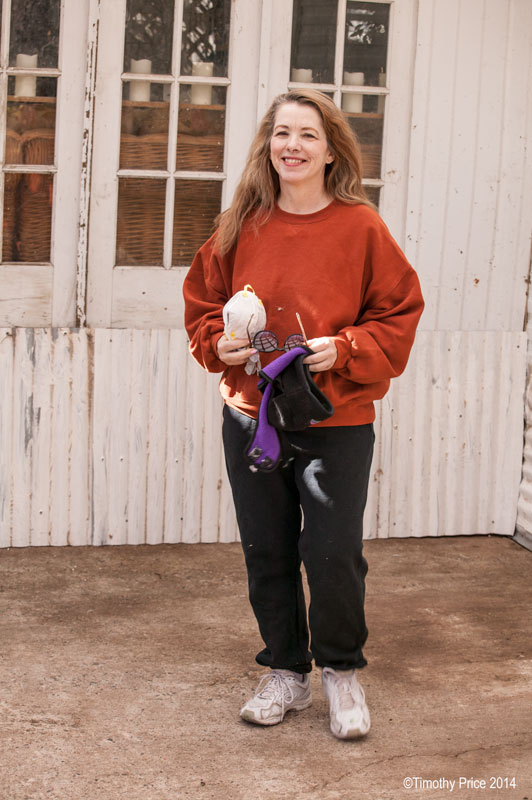
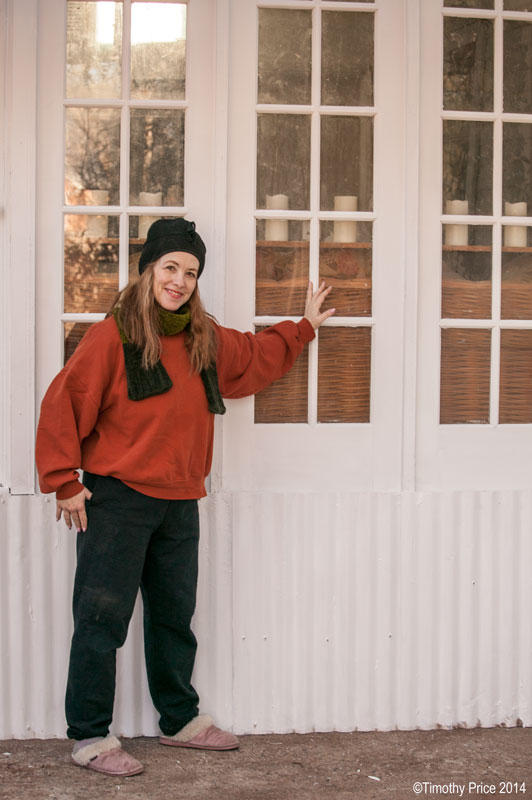
The first photo is Laurie preparing to wire brush the French windows so I could paint them. In the second photo, she is telling Rosencrantz and Guildenstern what they could do to help. The third photo shows Guildenstern supervising Laurie. He had a lot to say about our work, so much so, that it wore him out and he had to take a break (fourth photo). The French windows and door had not been painted in 22 years. The ivy had grown up on them which marked and pulled off paint in various places, so I spent a good part of the day painting the windows and doors with a very good, “stain killer” primer. The last photo shows Laurie standing by the freshly primed windows.
As I have mentioned before, we live in a cold spot — the reason Laurie was dressed in layers of warm clothes to work on the catio. We went to a dinner party last night in Albuquerque. When we left the party at a little after 10:00 PM, the car showed the outside temperature was 47º F. When we got home 20 minutes later, the temperature at our house was 26º F. We live about 10 miles north and west as the crow flies, and about 700 feet lower than the part of Albuquerque we attended the dinner party, yet we were 21degrees colder.


 Off Center & Not Even