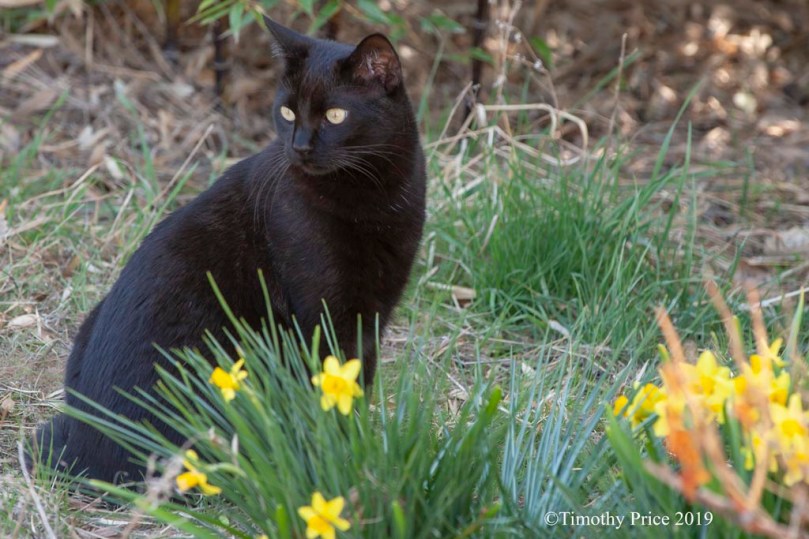
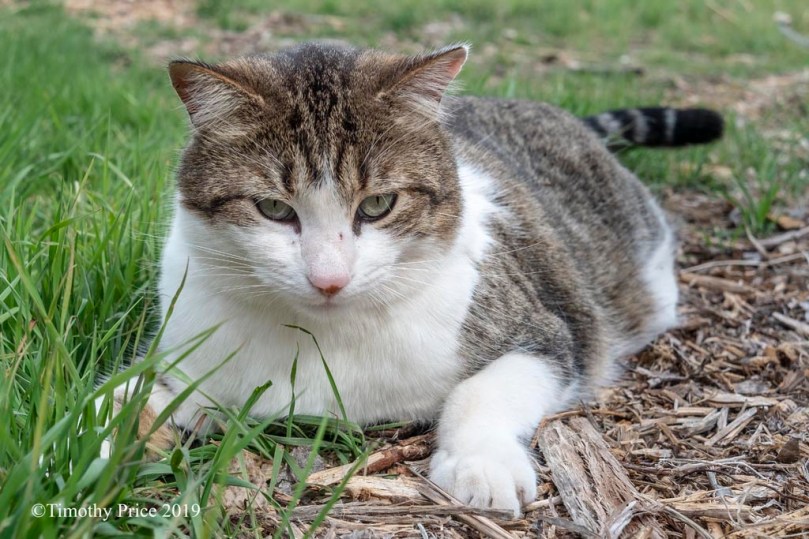
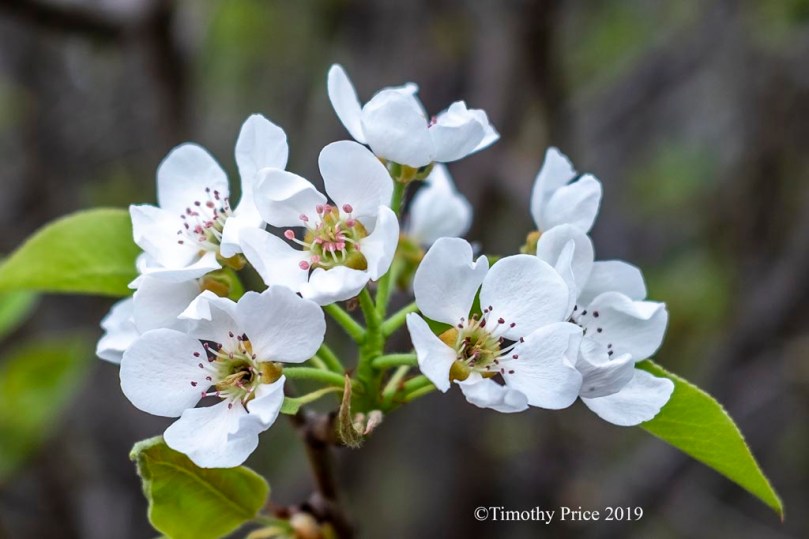
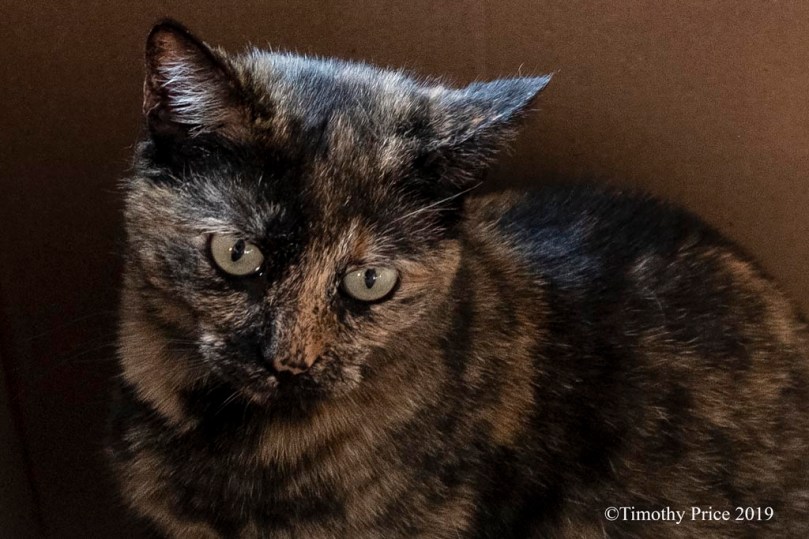
This week’s improvisation is called Saturday’s Improv (not a very creative title I know). I find playing lead guitar solo improvisations are very difficult. Coming up with fresh melodies is most frustrating. So I’ve started laying down base tracks: percussion, rhythm guitar and bass, and them playing improv solos all the way through the song, and taking them however they come out. I laid down all the tracks and the solo work today between watering, doing chores around the house, and taking a couple of walks in the bosque. There are two different guitar solo improvs that are very raw as the song goes back and forth between modes. I’m having lots of fun, and thought I might as well share the fun. I’ve include photos of Loki, Spunk and Marble, a photo of pear blossoms, and a photo of my darkroom/music studio showing the 10 tracks that make up Saturday’s Improve on the computer screen.
My music studio in my darkroom.SpunkPear blossomsMarble
Meet Jimmy Smith — guitar player, guitar teacher, guitar repairman, and guitar builder extraodinnaire. Not only is he great guitar enthusiast, he’s a master craftsman, studio tech and all around nice guy who loves Fender Stratocasters and their shapely features.
After playing in a band through the eighties, where he maintained all the instruments and built sets for the band, Jimmy started repairing instruments, and building his own guitars. He opened for business in Olympia, Washington in 1999 before he and his wife, Lisa, moved his business to the Durango, Colorado area a couple of years later. They finally relocated to Corrales, New Mexico in 2009 as GRS Music.
Jimmy changed the name of the business to The StratAcademy around 2016, and moved to the current location on Corrales Road a year ago. The StratAcademy is made up of a small retail space, his repair shop, a music studio for practice, lessons and recording, and a larger shop where Jimmy builds guitars and holds seminars on building guitars where students build their own solid body electric guitars from scratch under Jimmy’s tutelage.
Jimmy likes to experiment with different woods and materials for guitar bodies and necks. He is experimenting with Oriented Strand Board (OSB), commonly known as flake board, to build guitars. This is the second OSB guitar he is building with a Les Paul style body. He built a Strat style guitar out of OSB which will have its own post after Jimmy finishes a video of him playing it so we can hear how it sounds.
Jimmy explaining the OSB process.OSB neck for the OSB Les Paul.
This body is made of a hardwood that is very lightweight. It feels like a hard balsa wood. You can see neck and body templates in the shelves behind Jimmy.
A Texas Flag Telecsater body Jimmy got from a pawn shop.Jimmy made this body out of 2x4s used to frame buildings.
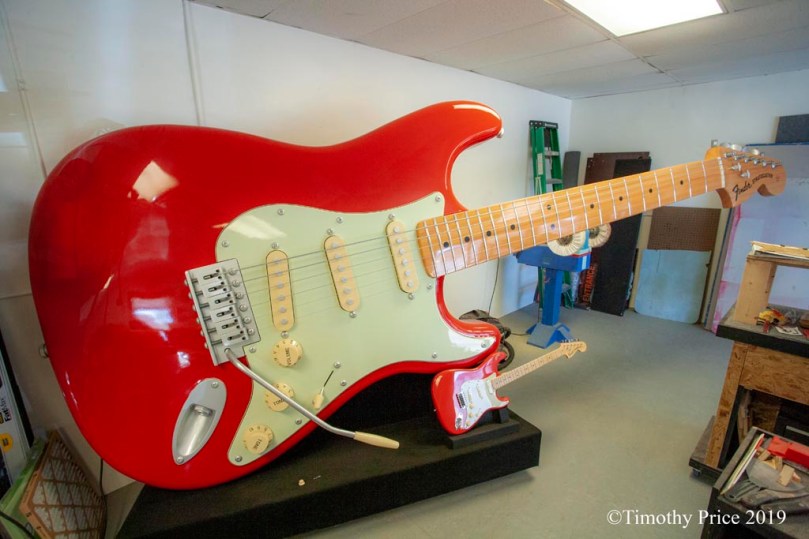
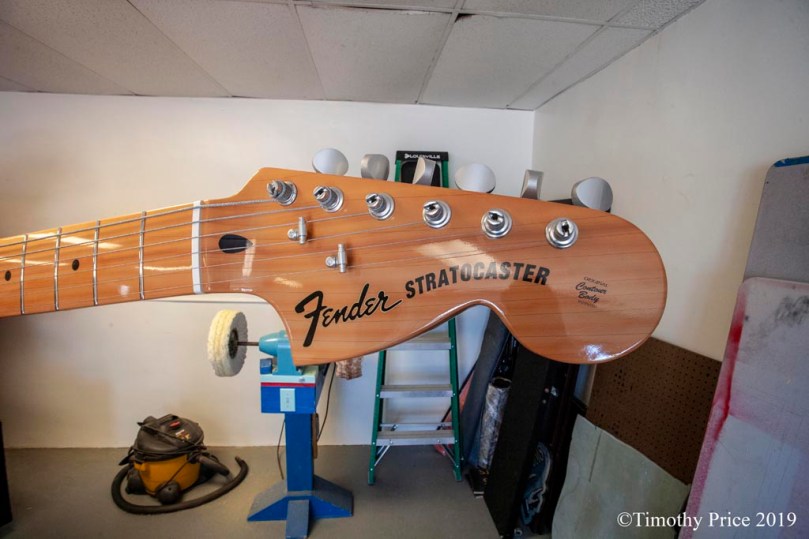
Jimmy Smith’s 16 feet long Fender Stratocaster with a real Strat for scale.
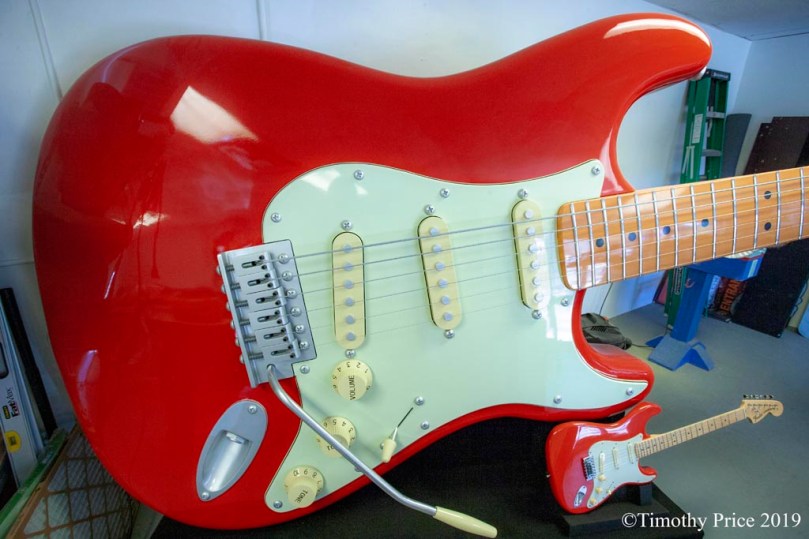
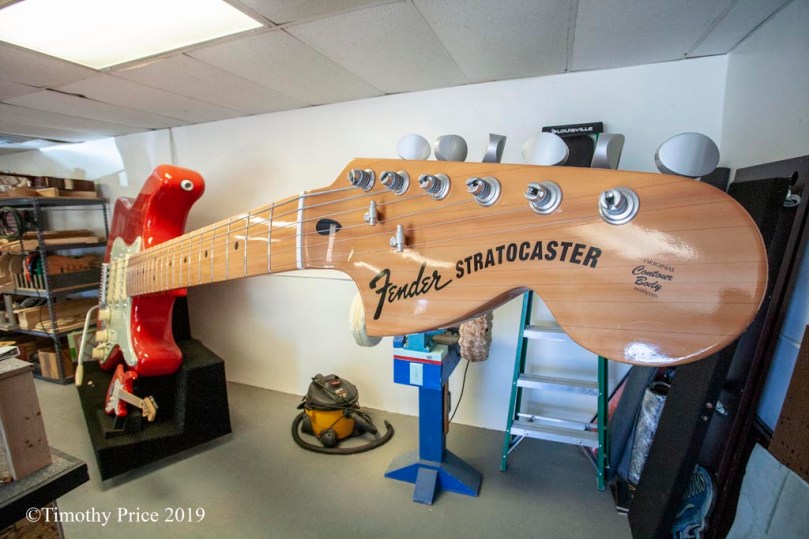
When I first saw the giant, 16 foot long, exact replica of a Fender Stratocaster that Jimmy Smith built, I was so impressed with the quality and workmanship of the monolithic guitar sculpture, the question of why would Jimmy go to all the trouble to build it never crossed my mind. It’s art pure and simple with so much care and attention to every detail of the iconic guitar first produced by Leo Fender’s electric instrument company in 1954. Buddy Holly bought a Fender Stratocaster in 1955. When Holly played in England in 1958, the shape and sound of Holly’s solid body electric guitar mesmerized John Lennon and Paul McCartney, providing inspiration to the two teenagers that would eventually change the course of contemporary music. We can only imagine what Buddy Holly would have achieved if he had lived, but in that short time before his untimely death in 1959, Buddy Holly unleashed the Fender Stratocaster on the world, and made a significant contribution to the rock & roll revolution. The Stratorcaster is memorialized at both Buddy Holly’s and Jimmy Hedrix’s grave sites. Holly’s Stratocaster is carved on his headstone, and there is a sculpture of Jimmy Hendrix’s stratocaster, strung for his left handed playing, at his grave site. To me there is no mystery about why a master craftsman like Jimmy Smith would build a monolithic sculpture of Leo Fender’s Stratocaster. A stratospheric work a art to commemorate a work of stratospheric art.
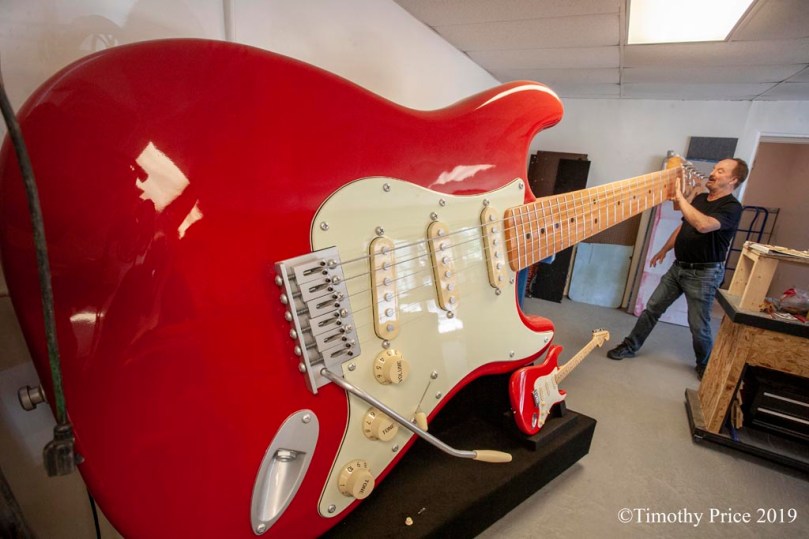
My friend Joel trying to play the big Strat.Jimmy’s artistry and attention to detail is exquisite.
Jimmy has to keep it in his shop. When he puts it out in front of his shop, The Strat Academy, people climb on it for photos and selfies and it gets vandalized.
Stay tuned, and you will learn more about Jimmy Smith and the Strat Academy in upcoming posts.
The third flamenco show we saw ended with guitarist Moraito Chico dancing a sassy bularias as everyone left the stage. The fourth flamenco show ended with polite applause for the dancer and the house lights coming on the user her group off the stage.
18 April 1996
Flamenco
The fourth flamenco concert was Rancapino and Chaqueton accompanied by Paco Cepero. I think I now understand the difference between being in compas and having a mastery of compas. Paco Cepero was delightful in accompaniment of Rancapino and Chaqueton. He proved to be a masterful accompanist, who left large spaces for the singer, brilliantly followed their cante, and filled the voids between versus with astonishing acts of rhythm with such mastery of the compas that he many times set the crowd roaring with gritos and applause, and delightful looks of approvals from the singer. He was not in the least a flashy player as we generally know them. He only had occasional burst of lightning picado, and his aso pura (a thumb technique) seemed slow by most standards, but his thumb work was very strong and accurate. His flashiness was in the compas. He was so comfortable with it, and so accurate about it, that he made the guitar sing like I have never heard. His accompaniment was soft, and airy during the cante, leaving ample space for the singer to impress upon the audience the full intention of his art in expressions, emotions, and vocal achievement. In some instances Paco would tastefully play the cante along with the singer emphasizing the intricacies and complexities of the compas so masterfully he about brought the house down. There was no better rhythm for Paco to show his superior sense of compas than bularias. He would leave so much space, play so many complex rastiados, and supported the singer so beautifully that his masterful jesting had everyone on the edge of their seats, bringing roars of approval and amazement from the audience, and even slight looks of approving astonishment from the singer. Everybody was amazed by the performance. Both singers were excellent; however, I liked Rancapino best of the two.
Fosforito and the young guitarist, who sat in instead of Enrique del Malchor, were quite a contrast to the masterful playing and great compass of that previously mentioned. The guitarist was an excellent player, very fast and modern. He was not as good an accompanist that night, however. There was a constant tension between the guitarist and singer, the compas was often funny, but not really off, between them, and the guitaist was always busy and overpowering of the singer. The many long, lightning speed scales, and modern chords did not seem to belong as part of the accompaniment, and were really more distracting and overpowering than complinentary to the cante. I could have done without both of them that night.
Sara Baras danced a lame Alegrias. She did not have one interesting move, her hands were ugly, she looked down most of the time, her neck was lost in her raised shoulders, she did all her taconeo with very bent knees, which she insisted on showing us, as she spent more time pulling her “butt hugging” dress up over her butt, exposing her overly bent knees, than she did dancing. I really could of done without her. I saw several members of the audience get up and walk out with disgusted looks on their faces during her performance. The audience was cold to her (refreshing to be among people who know a bad dance when they see it) and luckily she did no more. At the end of her dance, there was a polite applause from the audience, and then the house lights were brought up before the group had left the stage.
Next the fifth and final flamenco show I described in the April 18th letter Videos: Actuación Paco Cepero y Rancapino Chico en los Claustros de Santo Domingo Jerez https://www.youtube.com/watch?v=wYT9wdTmX9U
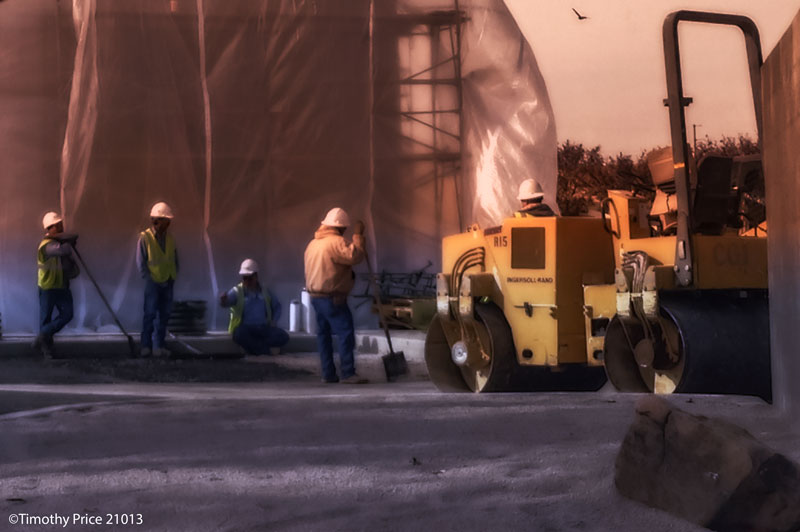
There is a stereotype of road workers standing around leaning on their shovels. While this photo reinforces the stereotype, I believe these guys are waiting for a fresh load of asphalt. I worked construction when I was young, and no matter what the stereotypes are, construction workers have hard jobs, and often have to work outside in bad weather this time of year. I remember digging footings and having to use a pickaxe to break up the frozen soil in single digit temperatures back in my days as a construction worker. I was young and stupid back then.
But today’s photo reminded me of when we were living in Spain, and we came home one summer. Tristan had a rat that died and we were having a funeral for it. I had dug the hole and was leaning on the shovel, with Laurie and my parents gathered around the hole while Tristan read from a book of prayers from the Spanish Reformed Episcopal Church. While we were in the middle of the funeral for a rat, one of my guitar students drove up in his pickup truck with his windows down and music blasting, parked, got out and asked what was going on. I told him we were burying a rat, so he stood around the hole with us while we finished the last rites, then I gave Tristan the shovel, and went off to give my student his guitar lesson. After we started the lesson my student paused and said “I’m sorry I barged in on the funeral like that. When I saw everyone standing around a freshly dug hole, and you leaning on a shovel, it looked like a normal work project for New Mexicans!”
On my way to class on Friday, the young man with the guitar was sitting alone playing and singing at the to of his lungs, and not very well. As I walked by after class, the blonde with the harmonica had joined him in performing a horrible rendition of “Hey Jude” (to be fair, only the singing was really bad, but not terribly objectionable for some reason). They were so involved in the song they didn’t noticed that I had stopped to photograph them, and they were doing the song so badly, they bordered on performance art. As I continued on my way, the guitarist started singing “nah nah nah nana nah nah…” so off key, and out of compas, that I burst out laughing and laughed all the way back to the office.
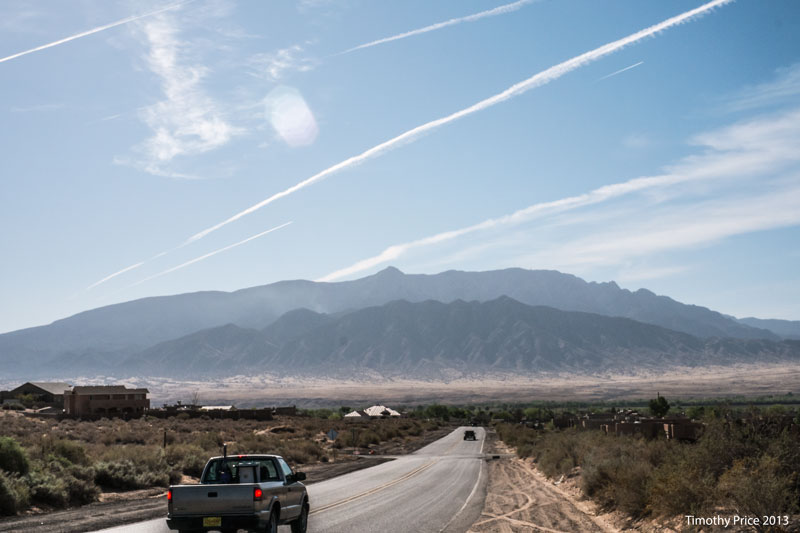
I took a load of trash to the dump today. I left early and got up to the entrance I’d always turned into and there were no other cars. “Nice!” I thought to myself. As I drove up to the building to pay, the attendant came out and said “The dump entrance is up the road before the light — this is recycling.” He told me to drive straight ahead and follow the road around. I followed the road through about twenty people eagerly waiting for stuff to recycle — they looked disappointed when I drove on by. I got back out on the main road, drove up toward the light, and found a long line of trucks waiting to get into the landfill. Forty-five minutes later I discovered I was in the line for the scale, but I couldn’t change lanes, so I drove onto the scale, walked up to the window and told the attendant that I didn’t need to be weighed. She said “that’s okay, but the people behind you will be mad when they see you turn the other way!” She asked for my license plate number, my proof of residence in Corrales, and driver’s license, then when I went to give her a $5 bill to pay the $4.75 fee, she told me it was a “free day!” “So that accounts for the long line of trucks them?” I asked. She nodded “Yep!” and told me the line would probably go down to the roundabout by noon. If I’d known it was a “free day” I wouldn’t have gone. I would have preferred to pay $4.75 to dump the trash then spend an extra 45 minutes waiting in line to dump the trash. I took the photo of the Sandias on the way home from the dump.
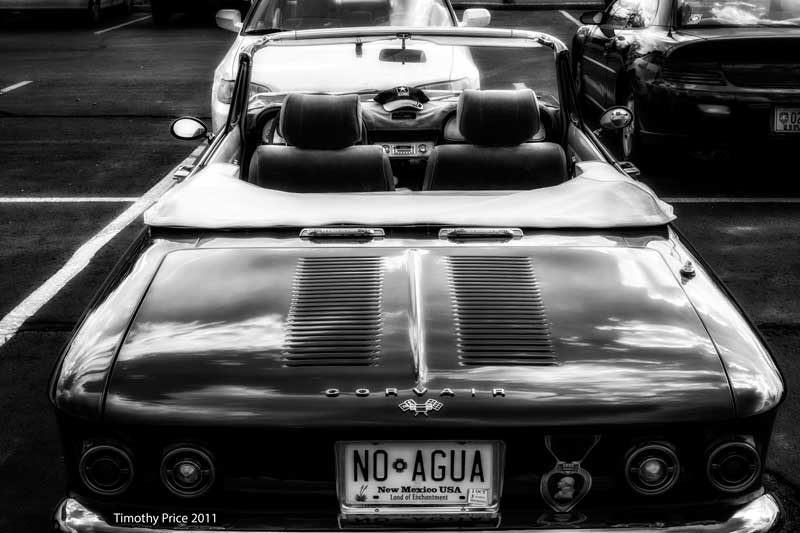
Since I am up past midnight, I thought I’d be clever and go out and see if I could get irrigation water since the ditch rider just turned it in to our ditch for the week. All the water was already taken. The farmers above us probably leave their gates down so when the ditch rider turns the water in, the farmers upstream of us will be sure to get it. The license plate on this old Corvair says it all!
For those of you who are old enough, and have good memories, the Corvair was on par with the Devil in Ralph Nader’s “Unsafe at any Speed” published in 1965. The only reason I remember it is because we had one of “The Sporty Corvair-The One-Car Accident” as per Nader’s title of Chapter One in “Unsafe at any Speed”. The Covair is long gone, but our evil, water guzzling plants remain, and the Conservancy is making Corrales farmers fight for water, leaving us with “No Agua” for three weeks at a time.
The “Check Engine Light” came on in our Mazda Speed 3 this afternon. I stopped and reseated the gas cap and checked the oil, and everything seemed ok. We had just filled the car with gas, so I suspected the gas cap didn’t get seated well enough. I took the car by Auto Zone and they got the code for me which gave use an error that there was a “Large Vacuum Leak” meaning the gas cap didn’t seat properly.
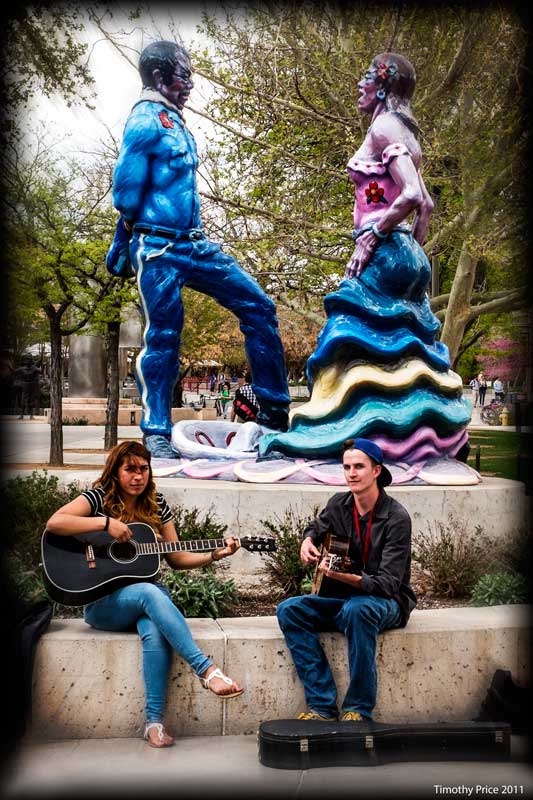
As I was walking back to my car after class, a young couple were playing guitars by the statue of “Mexican dancers” on the mall between Popejoy Hall and Johnson Gym. I noticed the young man was playing a flamenco guitar with pegs instead of machine heads to secure and tune the strings. Tuning pegs are rarely seen on guitars these days, so I asked the young man about his guitar. He said he got it from John Truitt and that is was made in Albuquerque by a local luthier in the 1970’s. That was really cool to learn, because I’ve known Truitt for many years, and he is like Mr. Music — you can give Truitt anything with a string on it and he’ll produce great music on it.
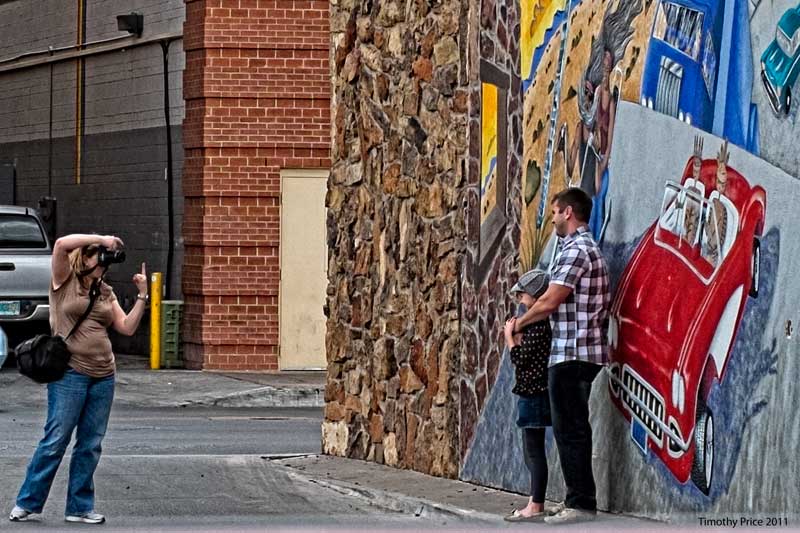
When I pulled into the parking lot at work, the was a young woman photographing a man and his daughter. I pointed out other locations in the downtown area that were good for portraits. They were friendly and cheerful and it made me happy to see they were having lots of fun with their photo shoot.
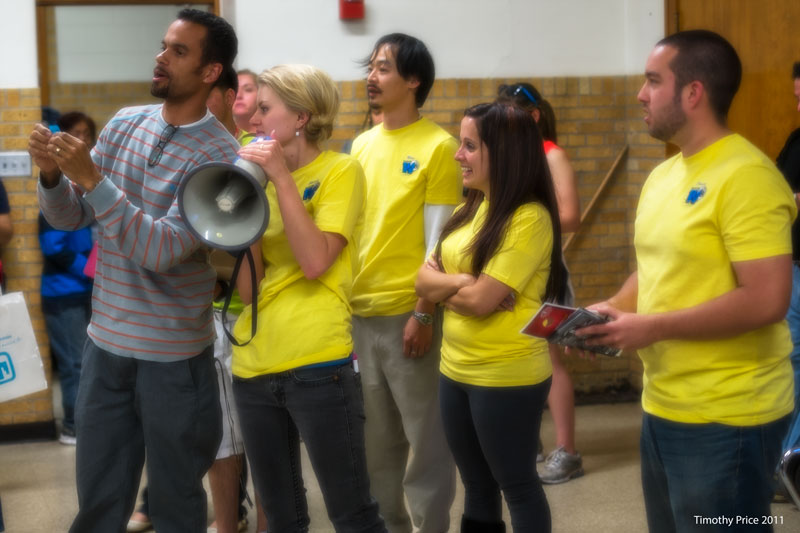
Sarah, who’s in French 385 with Lauie and I, and French 302 with Laurie, organized a fun night at Wilson Middle School with four or five other students for their senior project in Communications. It was really well attended, we had to park a block from the school, the food was good and the kids looked like they were having a lot of fun participating in art, science, poetry, etc. The 5th photo is of her team calling out numbers for a raffle.
On my way home from getting the engine light checked, a crew was filming at the Corrales gas station, so I pulled over and got a few shots. I have no idea what movie or show they were filming.
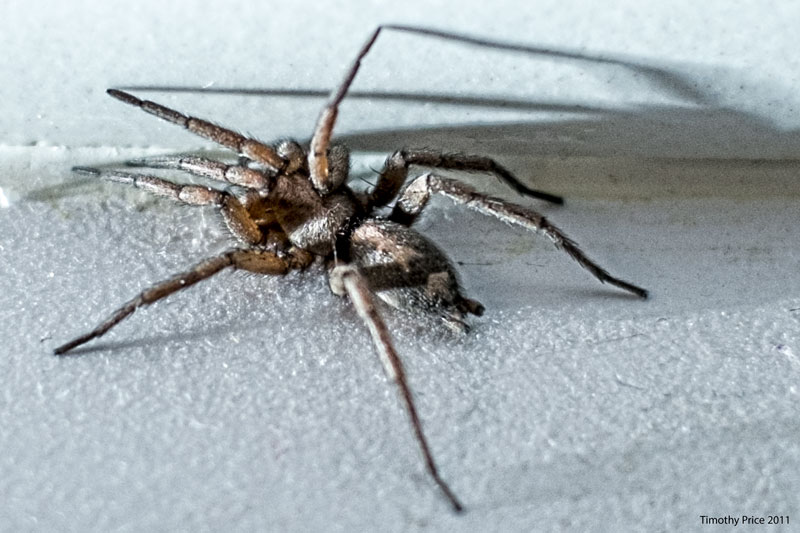
Laurie pointed out the spider in the last photo after she got home. It looks like spider season is coming on, so the macro lens is coming out.











 Off Center & Not Even