T.U.L.I.P. on Tuesday

T.U.L.I.P. on Tuesday not only has a nice alliteration but John Calvin, the person responsible for T.U.L.I.P., was born on Tuesday, July 10, 1509. If you are a Calvinist, Presbyterian, or know your theology, you will be familiar with T.U.L.I.P. also known as The Canons of Dort: total depravity, unconditional election, limited atonement, irresistible grace, and the perseverance of the saints. The Canons of Dort were a rejection of the Arminian views and set forth the Reformed doctrine at the conclusion of the Synod of Dort that started on Tuesday, November 13, 1618, and ended on Wednesday, May 29, 1619. I’m going to assume T.U.L.I.P. was finalized on the 179th meeting, Tuesday, May 28, 1619, before the final meeting on the 29th to keep my Tuesdays’ associations with T.U.L.I.P.

Below are five short songs† I wrote and recorded one for each letter in T.U.L.I.P. Why you ask? I’ve been brushing up on my studies of the history of Christian theology, and I was inspired to write the songs after going through the section on Calvin and Reformed doctrine.

Total Depravity

Sitting shivering
In the heat of night
Sliced by rays
In the dark of light

Soul lies frayed
So depraved

Every thought a mortal
Every action a mortal
Every thought and action
A mortal Sin!

Unconditional Election

Some are elected
Others left in sin
Punished and damned
For their many transgressions
They can never win

Those few saved by grace
Unconditional love
Receive salvation
They are the few
Elected from above

All others
All the others
All the others get
All the others get damnation

Limited Atonement

Limited Atonement
Didn’t die for all
Elected are saved
Reprobates fall

No prevenient grace
Jeopardy double
Only the elect
Will make it through
Without any trouble

Redemption certain or
Redemption none
It’s predestination
Foreknown by

The One

Irresistible Grace

Irresistible Grace
Efficacy calls
Only some
But not all

For salvation

It could be me
It could be you
It may be neither
Grace for the few

Is Irresistible

Perseverance of the Saints

One saved always saved
No more death by
Trespasses and sins
Security of sanctification

Condition is secure
Eternal justification
Salvation for the
Saints persevere


†All songs are written, performed, recorded, and copyrighted by Timothy Price.

Let Your Light Shine

SunOverBuilding

I’m listening to a course on the history of Christian theology, and the last lecture I listened to was on how Christians came to the idea of the soul separating from the body and going to Heaven or Hell when they die. Believe it or not, the idea of the soul going to heaven when one dies is not in the least bit Christian in origin, or even Jewish for that matter, but purely from Plato. If you stick by the Christian tradition, Christ returns to establish God’s Kingdom on earth and resurrects those Christians who are saved to be part of the Kingdom of God on earth. So why is the idea that our souls go to Heaven or Hell when we die so prevalent in the Western Christian tradition? Mostly because Augustine was well versed in Plato and liked the idea of a separate body and soul, but he still believed there had to be the resurrection of the body before the soul could achieve complete happiness. One problem is that Paul and the other New Testament writers believed Jesus would return in their life-time, so there was no problem about what happened when a Christian died, but as time wore on, later Christians became anxious about what happens when they die. In a simplistic way of looking at a very complex and drawn out issue, Plato had the easy answer — good souls go to Heaven and bad souls go to Hell — but then there are the questionable souls, that, again because of Augustine, are believed to end up in purgatory, at least in the Catholic tradition!

Father Justin

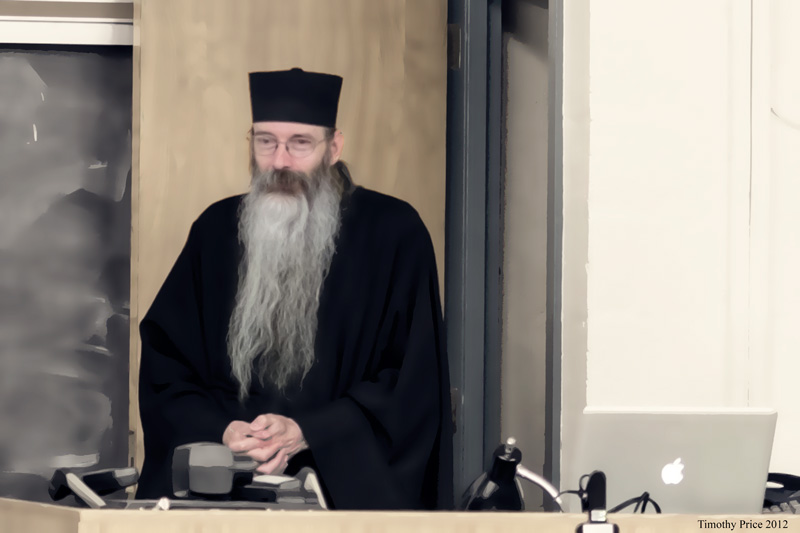
We went to a lecture by Father Justin of St. Catherine’s Monastery, Mount Sinai last night as part of the Medieval Studies lecture series. Father Justin is the Librarian at St. Catherine’s Monastery, which was built by Justinian in the sixth century, and is the oldest continuously inhabited Christian monastery in the world. His talk was on “Continuity and Change at Sinai from the Seventh to the Ninth Century: Insights from a Sinai Palimpsest.”  The palimpsest is a page from a set of manuscripts of the Epistles of St. Paul written in Greek with accompanying, parallel Arabic text from the 9th century. The manuscripts were left or forgotten in a room in the monastery where the roof collapsed and buried them. They were discovered in 1975 during renovations to the room. The manuscripts provide a great deal of information about the time when the Christian church in the Middle East was having to deal with the Islamic presence. Using modern photographic and digital technology, Father Justin has been able to not only study the writing that is currently on the manuscripts, but also enhance and make earlier text that had been erased legible so the previous writings can now be analyzed and studied, as well.

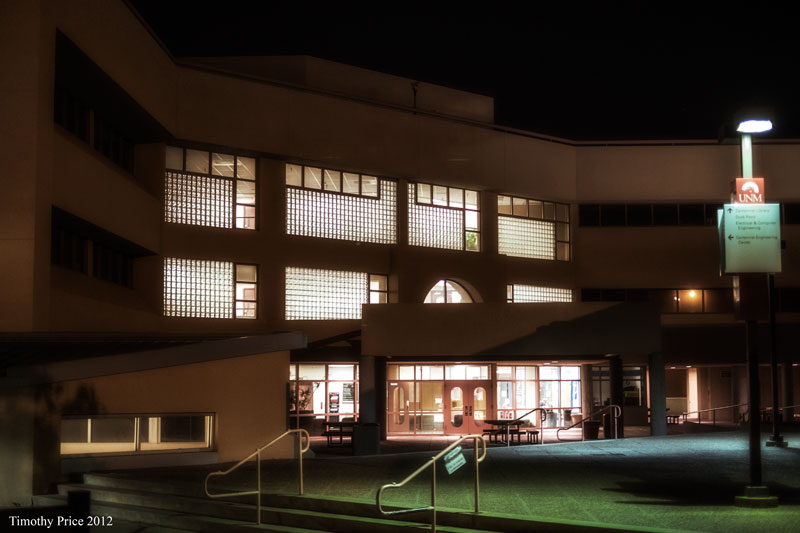
As we walked back to the car, I took a few photos of the buildings and features on campus. The architecture and lighting on UNM’s campus provide so many photo opts that I can’t recall setting foot on campus at night within the past four years without taking at least a half a dozen pictures.