
Letters from Madrid – 3rd Flamenco Show

lycfrm
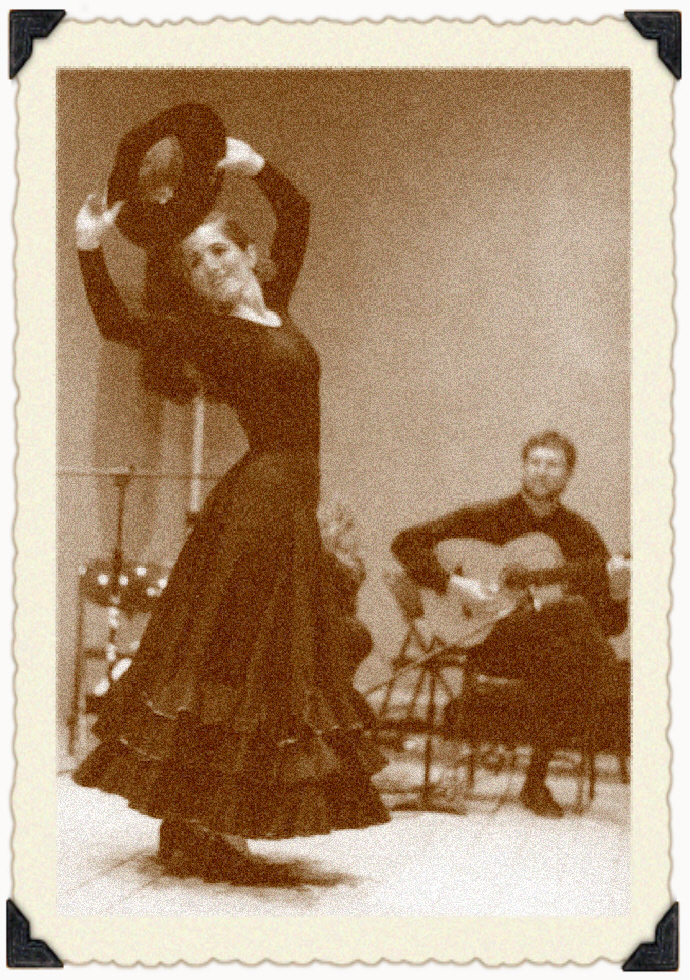
Laurie dancing Tangos with a hat. I’m accompanying her on guitar during a show in the Old Church in Corrales, NM in the 1990’s. This was before we went to Spain.

After the first two flamenco shows we saw in Madrid, we were starting see how shows that featured singers and guitarists where staged and arranged, and the third show with Moraito Chico, Fernando de la Morena, La Macanita, Moraito Hijo (Diego del Marao), and Dieguito de la Margara was no different.


18 April 1996

Flamenco
The thrid flamenco show was really fun also. It started with Moraito Chico, the guitarist, a tall thin man, with greased hair and oval rimmed glasses playing a solo, seguiraya. Then Fernando de la Morena, one of the featured singers, came out and sang occapela. He was an older man who wore a double breasted suit and sang with a loud, low voice He made great faces, and there was dead silence during the pauses in the letra, which he broke as he attacked the next phrase with the full force of his voice. This contrast was very beautiful. He walked off the stage, and a few minutes later Moraito Chico returned with 3 palmeros. After situating themselves, a slightly large woman, but not fat, with a round pretty face, thick red lips, jet black eyes and black hair pulled back on her head, wearing a fire red dress, appeared on the stage. This was La Macanita and she had a wide smile and brilliant white teeth framed by her pretty red lips. She was greeted with “La gitana guapa!” from the audience as she walked on the stage.

Her voice was low and sultry, not really powerful. She made slightly pained facial expression, pointed into the crowd, stretched both arms in front, moving them to her side and then she would elegantly place both hands over her heart as she closed a stanza. She turned her head slightly towards the guitarist as he filled the spaces between the letras, allowing the audience to gaze upon her pretty face, and comely features of her head. When she finished a song she would dart up out of her chair and take a few steps toward moving off stage, then stop and bow and signal for the guitarist to stand and bow. She sang a soleares, zambra, and bularias.

She, the guitarist and palmeros left the stage. In a few minutes Moraito Hijo, another guitarist, Fernando de la Morena, and three plameros appeared on stage. Moraito Hijo, who is a nephew or some other relation to Moraito Chico, was tall, very young between 18 and 22, and obviously not as experienced a player as Moraito Chico. He was obviously very nervous, and he slouched over the guitar, a strange position from the very straight posture of most of the guitarists we’ve seen perform. He started playing with the very basic most simple notes, chords and style possible. He also arrived at the cords slightly ahead of the singer (out of nervousness and obviously inexperience). As he played he became more confortable and the playing was better. The singer sat with his feet together, his hands on his thighs and a serious expression on his face, it was very powerful. He sang a soleares, seguiraya, fandangos grande and bularias. During the bularias Dieguito de la Margara, who was one of the palmeros, came out and danced. I learned later, from Angel Torres, that Dieguito de la Margara danced until he was 14 years old, then became a professional soccer player. He retired at age 30 and is now back to dancing.

The second set included both guitairsts, the two singers, three palmeros and Dieguito de la Margara. La Macanita sang a bularias, danced a little and came out and sang to the audiance from the edge of the stage without a mic. This caused a bit of alarm among the guitarist who abviously could not hear her over the monitors. They made the best of it and she finished her letra and danced off the stage. She came back out, set down and Fernando sang a bularias. During his letra each of the palmeros came out and danced, Dieguito de la Margara danced, and then the La Macanita danced with Dieguito de la Margara and they dance off stage. The audince brought everyone back for an encore during which Fernando took Moraito Chico’s giutar from him and made him dance. He actually danced very well, did a couple of nice moves and then danced off with the group moving his hips in that sassy bularias style. It was really fun.


To be continued with the fourth flamenco show…

 
Videos
Moraito Chico – Seguiriyas.wmv https://www.youtube.com/watch?v=xV2EBQAsI9I

Moraíto Chico & Fernando de la Morena https://www.youtube.com/watch?v=_-B8rWQYIg8

Fernando de la Morena – fandango grande! 2015 (en la Garcia Lorca) https://www.youtube.com/watch?v=nZbfDXQSEH8

Canta; La Macanita Guitarra; Moraito Chico Bulería por Soleá https://www.youtube.com/watch?v=VKKvi20BzO0

La Macanita, Parrilla y Moraito – Tangos https://www.youtube.com/watch?v=RD6NTgqn-NY

BAILANDO-MACANITA-PARRILLA Y MORAITO https://www.youtube.com/watch?v=FebNWmD-J18

DIEGO DEL MORAO – Del Cuartichi https://www.youtube.com/watch?v=lHUJSnsPia0 (Moraito Hijo)

Dieguito el de La Margara https://www.youtube.com/watch?v=aemwZLp7dEo (documentary when he was 14)

Jesus Mendez, Diego del Morao, Moraito y Diego de Margara – Bulerias https://www.youtube.com/watch?v=lCJjuYzg2gw (Diego de Margara as an adult dances near the end)


Letters from Madrid – 1st & 2nd Flamenco Shows

cheo1old.jpg
Me playing between dance sets in the 1990’s

After discovering the large and vibrant music scene in Madrid, and after seeing LaBanda live at Cafe Jazz Populart, we started finding flamenco shows, and went to five flamenco shows in the first 3 months we were in Madrid. Flamenco shows usually had several different performers that included singers, guitarist, dancers and various supporting musicians playing palmas (hand clapping), cajon (a box drummed on by hand) and sometimes flute and/or strings. Sometimes a show was simply a singer and guitarist, solo guitar or a dancer or dance group with accompanying singer, guitarist/guitarists and palmeros, but shows with many artists seemed to be more common. 

The first show we saw included Potito (singer) accompanied by guitarist Tomatito in the first part of the show and then Jose Fernandez (dancer) and his company the second part of the show. The second show was El Lebrijano (singer) accompanied by guitarist Enrique de Melchor with supporting palmeros.


18 April 1996

Flamenco
The first flamenco concert we saw featured Potito with Tomatito on guitar the first half and Jose Fernandez and company the second half. It was a good performance, but different from the shows we’ve seen at home. This was Potito’s debut performance promoting his new album. He sang and Tomatito accompanied. On some of the songs there was a second guitar, bass, cajon and palmero. Jose Fernandez is a dancer, and he was the only dancer. He had two guitarists, two singers, two palmeros, a cajon player and a cellist to support him. The theater is under the plaza at Colon circle, just down the street from where we live. The volume was not high and the sound was good.

The second show we went to featured El Lebrijano and Enrique de Melchor. El Lebrijano is an excellent singer, one of the best we have heard. Enrique is a fine guitarist. El Lebrijano’s voice is strong, his expression, delivery and sincerity are honest, and animated. He sings right to the audience and relates his stories through song with gestures and facial expressions that convey the convictions of his heart, soul and words. Enrique de Melchor is a flashier player than Tomatito, but was still very restrained as compared to many I have heard at home. His quick busts of speed, his clear tone, and clean changes assure the listener he is a fine guitarist, but again, he never does anything to upscale the singer. He is attentive, supportive, and does what is required to accompany and enhance the singer’s tonality. There were three palmeros that assisted at times and towards the end, one palmero, who was the same person with Potito, and I was thinking maybe he is a house palmero, got up and danced during a bularias, mocking the style of women dancers. He was very good actually, with strong, fancy displantes, hip movement, and great facial expression and greetos. On another bularias, El Lebrijano did his share of dancing while, the house palmero sang. The audience brought the group back 3 times for encores. This was good cause for them to call one of the other, younger, palmeros to dance. His dance was short and simple but fun, he is not a ham like the house palmero and the singer. The house palmero danced some more and then he and El Lebrijano danced together a little bit and danced off the stage together to end what was a very good show.

Next the third flamenco show…

Videos:
Tomatito & Potito | Caminillo Viejo (tangos) https://www.youtube.com/watch?v=34yscu_bAsQ

El Lebrijano & Enrique de Melchor – Seguiriyas https://www.youtube.com/watch?v=qr3gmRppEsc

Letters from Madrid – Music

DSCF0563
Insert of LaBanda’s No todo es Seda CD that the band members signed for me

In the last Letter From Madrid we were looking for flamenco classes and I had found a great guitar teacher. Today I move to the music scene we encountered in Madrid soon after we got there in 1996. I wrote the first letter I’m sharing on April 18, 1996 after we had been in Madrid about three months — we discovered at that time Madrid had a very active live performance scene, and we had already seen more than a dozen live performances by the middle of April. We were there primarily to study flamenco, and one aspect of studying flamenco was to go to as many performances by different flamenco artists as possible so we could see what was current, and the different styles of flamenco being performed. While flamenco was the majority of shows we saw, we went to every kind of concert from Rock & Roll to jazz to chamber music to classical. I found a spreadsheet that I kept on every concert and artist we saw perform live in 1996. The tally was 83 concerts and 187 individual performers.  

The “Music” section will take several posts because the descriptions of many of the performances we saw in the first three months in Madrid are detailed and long.

I discuss LaBanda in this post. They were the first band we saw perform live in Madrid, and after some time we became loyal followers of the band, groupies if you will, and got to know the band members well enough that we would sit around and talk with them between sets. Be sure to check out the Youtube videos at the end of this post. Two of the videos are from a TV series on the arts. The lead guitarist, Leo, talks about the group, and if you don’t understand Spanish, don’t worry, most of the time is spent on them performing live.


18 April 1996

Music
The music scene in Madrid is big and hopping. There are advertisements for concerts all over the place. Green Day is coming as are “The Smashing Pumpkins” as the posters have it written, Sting, Kiss (unplugged), the Sex Pistols (what’s left living I guess), Mark Knoffler and about every other currently popular or once popular group plus a lot of Spanish and European groups we don’t hear about in the states. There are classical guitar concerts, ballets, musicals, plays and orchestras playing almost every night. We went to a really good salsa dance with two bands that played until 5:00 am, and we saw Irakere, Cuba’s most celebrated salsa/jazz group. We have seen five really good flamenco concerts. We went to Jazz Club Populart on Friday nights in March and listened to the bands they have (April’s lineup didn’t look as good, we will have to see what’s on in May). The first band we heard was a Celtic music band named LaBanda and they were excellent. I would like to see them again. The second group was a blues group. They were pretty good. The leader is from New York and gave us his telephone number, and we have talked a few times since. We are planning to get together with him, his wife, and his daughter. We listened to a reggae band there also, but they did not do much for us. We have seen many ads for ballroom dancing but have not made it out to see what it’s like here. There is so much going on that we could spend every day and night of the week going to museums, concerts, plays, symphonies and discos, listening to whatever live music we are in the mood for in bars and night clubs. With that we would not even begin to see or hear a fraction of what’s available.

Celtic Music
The band that plays Celtic music is worth mentioning. The group is called LaBanda, and they were quite good and the music fun. There was a bass player, drummer, keyboard player, guitarist/vocalist, violinist and a guy who played all kinds of flutes, small reed instruments and the bagpipes. The music was a mix of traditional rhythms with a rock under-beat. The tunes went from traditional to rock and roll. A lot of the tonality between the guitar, violin, and keyboard had an early Kansas sound to it. The band was tight, there was good balance on the sound, and they sounded great. They did lose a little of the Celtic quality from the vocal arrangements being sung in Spanish. However, in one song the guitarist/vocalist got the whole crowd to yell “hey”, “hey hey” at a break in the music. It was pretty funny hearing a bunch of Spaniards yell “hey”. The second time around he said we had to sound more English “you’re learning the language now” he said in Spanish, “say it” “heyy”, “heyy heyy” drawling the words into two syllables. This was even funnier. The band was not very loud. For a matter of fact, the band was having a bit of trouble competing with a few groups of Spaniards setting in the front of the bar. The guitarist finally went back and turned up the volume to drown out the Spaniards, which I think they only matched the volume. The evening was lots of fun and very entertaining.

To be continued…

LaBanda Videos
Labanda – Fin de Semana https://www.youtube.com/watch?v=JS5OXn8Dgfo

LABANDA. PROGRAMA ESPECIAL 1 DE 2 (1992) https://www.youtube.com/watch?v=sIQlkrzBuBU

LABANDA. PROGRAMA ESPECIAL 2 DE 2 (1992) https://www.youtube.com/watch?v=QbeLeRWHww8

LaBanda – La Batalla De Somme https://www.youtube.com/watch?v=0wTV3J3WJIs

Letters from Madrid – The Paperwork is Done

The first letter from Madrid left the us worn out from crisscrossing Madrid trying to finish up the paperwork for our residency cards. The saga continues with us looking for flamenco classes, a description of where we lived and Tristan’s schooling. She was 9 years old when we moved to Spain.

18 April 1996

Madrid, Spain
With the paperwork out of the way, Laurie and I went off in search of flamenco classes. Of course finding dance classes was not difficult and Laurie is taking class every day for two hours, and is looking into adding some other classes. I got lucky, and found an excellent guitarist, Miguel Rivera. who has taken me as a student. He was recommended by Pablo’s old teacher, Angel Torres. Miguel is a superb player, fast and clean like Paco de Lucia, very tasteful and very knowledgeable. He is constantly on tour with flamenco groups, so I get lessons when he is town for a couple of days between shows. He is performing in northern Spain, Italy and Poland for the next three weeks. He has me playing some very difficult material plus he has exercises for every technique and fingering I am deficient in (which is about everything). The style is very different from what I have played and is taking a lot of getting used to. I’m slowly adjusting and my speed and clarity is improving already. I am very excited about the guitar right now.

We live in the barrio called Chambari, in a small, but comfortable, fairly modern apartment. As it turns out, Chambari is a fairly upscale area, and this is the best priced apartment we have found so far, especially considering it has central heat and air-conditioning (Heating is not standard in apartments, and air-conditioning is rare) included in the rent. We are central to everything and right on a metro stop. There is a nice playground/park up the street from us where Tristan goes to play in the evenings. There are a lot of families in this area and Tristan has made several friends. There are real grocery stores fairly close by, a nice market down the street, a great book store around the corner, and the main branch of the public library up the road a bit. After looking at several apartments in the areas we like, we have come to the conclusion we are in the least expensive apartment we can find, so we are staying put at the moment.

Tristan is being home schooled, which is not something normally done in Spain, as most people don’t understand the concept. The Spanish schools are in session until the end of May and then have a break until the middle of September. We might put Tristan in School in September. Classes run from 9:00 AM to 5:00 PM Monday through Friday here. Tristan doesn’t even want to consider it at the moment. She has just finished a fourth grade math book and moved on to a fifth grade math book (she is a third grader). She is reading regular novels in English (middle to high school level), plus the Bible and some easier history, horse and bird books in Spanish on her own. Laurie is reading Don Quijote and Greek Myths in Spanish to her. Tristan has to do handwriting exercises and write at least a page, plus she has to write letters and post cards to friends and family. I work with her on Geography and Geology from a couple of very good, generally middle school level, text books. She has an Explora science book that she is reading and doing experiments on her own with. We go to the museums regularly so Tristan is getting art, art history and Spanish history. As she has learned from looking at the classic paintings, you have to know history, the Bible stories and mythology to understand many of the paintings. She is reading the Bible and discovering many of the stories in the paintings. She is also starting to understand and see a lot of the mythology and history in the paintings also. She is actually getting somewhat of a St. Johns College curriculum in her home studies.

We have not done a lot of site seeing outside of Madrid. There is so much to do here that it is tough to get out. We are what I would call micro tourists. We are getting to know an area of about 36 square kilometers in the center of Madrid very well; and that is a very small area of the city. We are finding all kinds of great museums and seeing great musical performances, learning the history of this wonderful city, and how to get about in it.

More to come…

While I did not take many photos the first couple of years we lived in Spain, I did find videos of Miguel Rivera, the guitarist I studied with in Madrid. Although the videos where posted on Youtube only in the past 5 years, some of them go back to the the 1990’s. The last one below that is very recent.

Flamencos de la Feria – Suite Sevilla Obra de Rafael Riqueni por Miguel Rivera y René Mora  https://www.youtube.com/watch?v=k5rBpcCFSCM (Miguel is on the right side of the screen)

El Real – Suite Sevilla obra de Rafael Riqueni por Miguel Rivera, René Mora y David Vázquez https://www.youtube.com/watch?v=U6WaVEGjRx4 (Miguel is on the right side of the screen)

Bulerías – Miguel Rivera https://www.youtube.com/watch?v=r51aSk7fDOI

Así suena el genial Miguel Rivera https://www.youtube.com/watch?v=63H-1EW9e_8 (Miguel in 2014)


Letters from Madrid – Residency

While searching through my archived files recently, I found letters I’d written home from when we moved to Spain in January 1996. The letters are compiled from the daily journals I kept at the time. I did very little photography when we lived in Spain, so you have to form mental images from my descriptions of people and events. 

I am going to publish the letters in pieces as they where very long and detailed.


18 April 1996

Madrid, Spain
Warning this is a form letter. Sorry I have had to resort to this, but this seems to be the only way I’m am going to be able to share some of the experiences, and observations of Spain, Madrid currently, with everyone I want to. Since I record my observations, impressions and experiences on a daily basis, this letter contains very detailed descriptions of them. If you don’t like to read or don’t have time, I won’t be offended, just pass it on to someone else. I am not inclined to photograph much of anything while I am here, so you will have to form your own images from the words on these pages. I am including what I think are the more interesting aspects of Madrid, and my experiences, thus far, taken from my journal and edited from letters I have sent to mainly family. The letter is long, so I am labelling the broad subjects with headings so you can easily skip any part you may not be interested in. I hope you enjoy it, and you can at least feel somewhat relieved to know that it will be months before I compile another form letter.

General Welfare of the Vagabond Price Family
We are all well. We got our paperwork completed and in the hands of the authorities during our first six weeks in Madrid. This was very trying on our patience as we made our way through the seemingly never ending gauntlet of bureaucratic inconsistencies, misinformation, and off-the-cuff rule making. We patiently filled out forms, walked here, waited in line there, got an address, opened accounts, bought insurance, got more photos, more copies, got official letters, got official inscriptions, got everything stamped by the right stamper, dated with current dates, and signed by ourselves and official parties, and, after five weeks of it, turned the bundle over to the authorities. The not so pleasant lawyer, who had the final say before the papers could be shipped off for processing, got it in his head that we had not suffered enough. He looked at the date from the letter from the bank on the status of the accounts we opened, and said “this date is ten days old! You will have to get another letter.” We were to say the least shocked at this, but he would not have anything less. We had already walked back and forth about 10 kilometers that morning tying up the final details of the paper work, and were a little out of patience; however, we walked 3 kms. to the bank and requested another letter (the bank officials were, I think, more surprised then we were at this request) and went home. We got the letter the next day from the bank, delivered it, got the final approval, and now we wait up to six months for our residency cards.

To be continued…