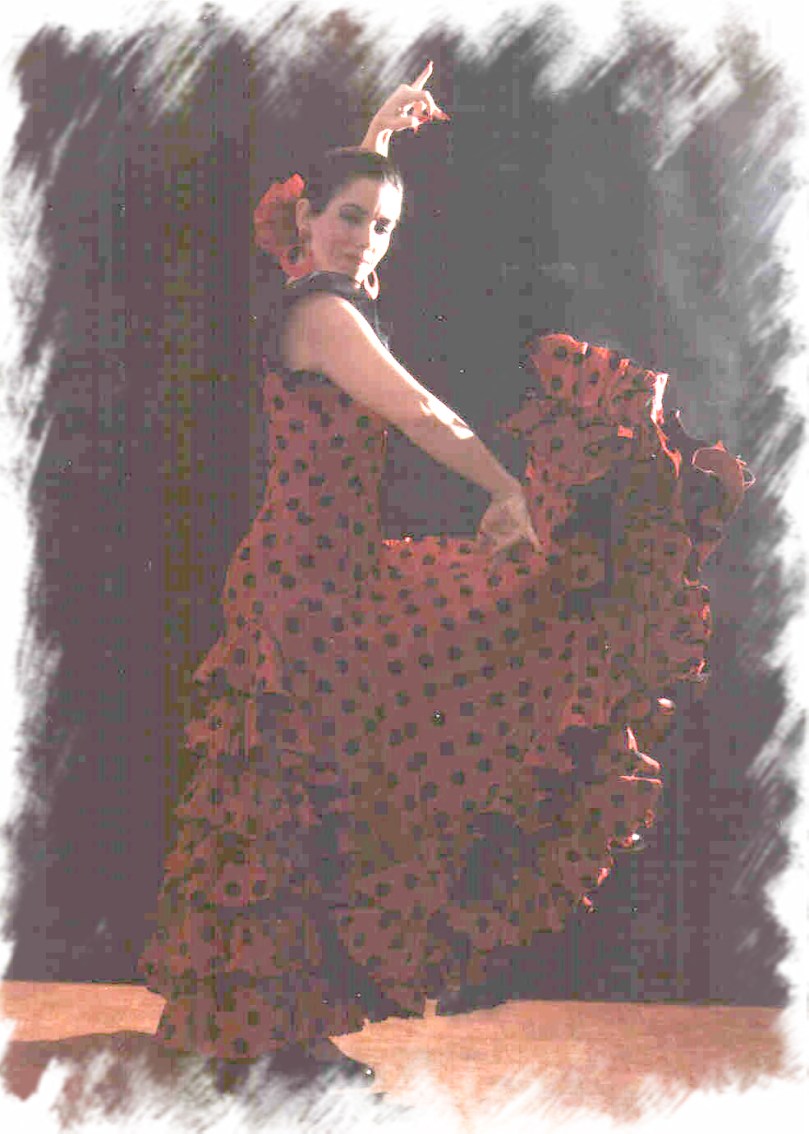
Laurie dancing Alegrías in one the dresses she designed and sewed herself.
Sara Baras didn’t leave much of an impression in the fourth flamenco show. Belen Maya was much more interesting, but singer El Chocolate made the show in the 5th and last flamenco show we saw during our first three months in Madrid.
April 18, 1996
Flamenco
The fifth show included Chocolate and had a more modern dancer, Belen Maya, who was much more interesting that Sara Baras, but had too few moves and became quickly boring. Chocalate was excellent, but the guitarist who accompanied him and the other featured singer was totally boring. The other featured singer is not worth mentioning, as he did nothing extraordinary. What was extraordinary is that Fosforito and the young guitarist sitting in for Enrique del Malchor were special guests again. They seemed to have worked things out, because they were both great. A total change from Tuesday night. The guitarist had toned down his playing a bit, smoothed it out, and set himself to accompanying the cante. I hope he realizes that, his attention to the cante, and playing a slight more reserved, and in a more tastful manner, brought it home to the audience what a fine guitarist he is. It could be that the first guitaist was so boring that the new sound, lightning fast scales, and quick changes seemed fresh and fun in compairosn, where as Tuesday, he seemed busy and overpowering after Paco Cepero masterful playing. On Tuesday, Fosforito and his guitarist got a cool reception from the audience; but this night, they excited the audience, bringing gritos and applause for the great playing and emotionally, heart rendered words pouring forth from Fosforito’s pained, squinting face.
For the next several posts of Letters from Madrid…, I’m going to turn from music for a little bit and get into my observations and reactions to museums, architecture and planning, parks and open space, public restrooms, driving and tourists during our first three months in Madrid!
The third flamenco show we saw ended with guitarist Moraito Chico dancing a sassy bularias as everyone left the stage. The fourth flamenco show ended with polite applause for the dancer and the house lights coming on the user her group off the stage.
18 April 1996
Flamenco
The fourth flamenco concert was Rancapino and Chaqueton accompanied by Paco Cepero. I think I now understand the difference between being in compas and having a mastery of compas. Paco Cepero was delightful in accompaniment of Rancapino and Chaqueton. He proved to be a masterful accompanist, who left large spaces for the singer, brilliantly followed their cante, and filled the voids between versus with astonishing acts of rhythm with such mastery of the compas that he many times set the crowd roaring with gritos and applause, and delightful looks of approvals from the singer. He was not in the least a flashy player as we generally know them. He only had occasional burst of lightning picado, and his aso pura (a thumb technique) seemed slow by most standards, but his thumb work was very strong and accurate. His flashiness was in the compas. He was so comfortable with it, and so accurate about it, that he made the guitar sing like I have never heard. His accompaniment was soft, and airy during the cante, leaving ample space for the singer to impress upon the audience the full intention of his art in expressions, emotions, and vocal achievement. In some instances Paco would tastefully play the cante along with the singer emphasizing the intricacies and complexities of the compas so masterfully he about brought the house down. There was no better rhythm for Paco to show his superior sense of compas than bularias. He would leave so much space, play so many complex rastiados, and supported the singer so beautifully that his masterful jesting had everyone on the edge of their seats, bringing roars of approval and amazement from the audience, and even slight looks of approving astonishment from the singer. Everybody was amazed by the performance. Both singers were excellent; however, I liked Rancapino best of the two.
Fosforito and the young guitarist, who sat in instead of Enrique del Malchor, were quite a contrast to the masterful playing and great compass of that previously mentioned. The guitarist was an excellent player, very fast and modern. He was not as good an accompanist that night, however. There was a constant tension between the guitarist and singer, the compas was often funny, but not really off, between them, and the guitaist was always busy and overpowering of the singer. The many long, lightning speed scales, and modern chords did not seem to belong as part of the accompaniment, and were really more distracting and overpowering than complinentary to the cante. I could have done without both of them that night.
Sara Baras danced a lame Alegrias. She did not have one interesting move, her hands were ugly, she looked down most of the time, her neck was lost in her raised shoulders, she did all her taconeo with very bent knees, which she insisted on showing us, as she spent more time pulling her “butt hugging” dress up over her butt, exposing her overly bent knees, than she did dancing. I really could of done without her. I saw several members of the audience get up and walk out with disgusted looks on their faces during her performance. The audience was cold to her (refreshing to be among people who know a bad dance when they see it) and luckily she did no more. At the end of her dance, there was a polite applause from the audience, and then the house lights were brought up before the group had left the stage.
Next the fifth and final flamenco show I described in the April 18th letter Videos: Actuación Paco Cepero y Rancapino Chico en los Claustros de Santo Domingo Jerez https://www.youtube.com/watch?v=wYT9wdTmX9U
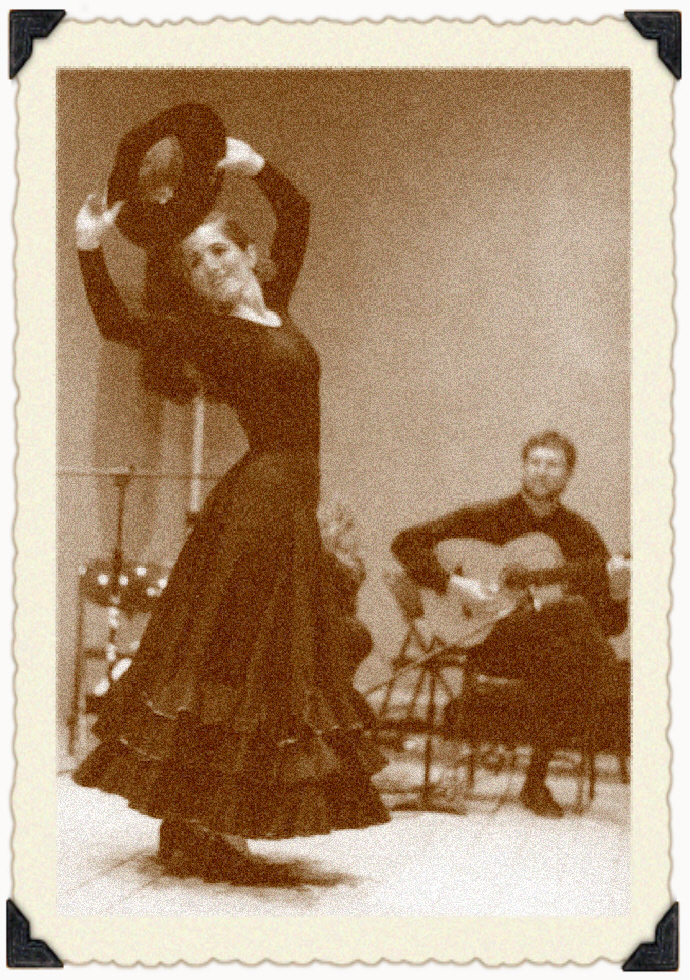
Laurie dancing Tangos with a hat. I’m accompanying her on guitar during a show in the Old Church in Corrales, NM in the 1990’s. This was before we went to Spain.
After the first two flamenco shows we saw in Madrid, we were starting see how shows that featured singers and guitarists where staged and arranged, and the third show with Moraito Chico, Fernando de la Morena, La Macanita, Moraito Hijo (Diego del Marao), and Dieguito de la Margara was no different.
18 April 1996
Flamenco
The thrid flamenco show was really fun also. It started with Moraito Chico, the guitarist, a tall thin man, with greased hair and oval rimmed glasses playing a solo, seguiraya. Then Fernando de la Morena, one of the featured singers, came out and sang occapela. He was an older man who wore a double breasted suit and sang with a loud, low voice He made great faces, and there was dead silence during the pauses in the letra, which he broke as he attacked the next phrase with the full force of his voice. This contrast was very beautiful. He walked off the stage, and a few minutes later Moraito Chico returned with 3 palmeros. After situating themselves, a slightly large woman, but not fat, with a round pretty face, thick red lips, jet black eyes and black hair pulled back on her head, wearing a fire red dress, appeared on the stage. This was La Macanita and she had a wide smile and brilliant white teeth framed by her pretty red lips. She was greeted with “La gitana guapa!” from the audience as she walked on the stage.
Her voice was low and sultry, not really powerful. She made slightly pained facial expression, pointed into the crowd, stretched both arms in front, moving them to her side and then she would elegantly place both hands over her heart as she closed a stanza. She turned her head slightly towards the guitarist as he filled the spaces between the letras, allowing the audience to gaze upon her pretty face, and comely features of her head. When she finished a song she would dart up out of her chair and take a few steps toward moving off stage, then stop and bow and signal for the guitarist to stand and bow. She sang a soleares, zambra, and bularias.
She, the guitarist and palmeros left the stage. In a few minutes Moraito Hijo, another guitarist, Fernando de la Morena, and three plameros appeared on stage. Moraito Hijo, who is a nephew or some other relation to Moraito Chico, was tall, very young between 18 and 22, and obviously not as experienced a player as Moraito Chico. He was obviously very nervous, and he slouched over the guitar, a strange position from the very straight posture of most of the guitarists we’ve seen perform. He started playing with the very basic most simple notes, chords and style possible. He also arrived at the cords slightly ahead of the singer (out of nervousness and obviously inexperience). As he played he became more confortable and the playing was better. The singer sat with his feet together, his hands on his thighs and a serious expression on his face, it was very powerful. He sang a soleares, seguiraya, fandangos grande and bularias. During the bularias Dieguito de la Margara, who was one of the palmeros, came out and danced. I learned later, from Angel Torres, that Dieguito de la Margara danced until he was 14 years old, then became a professional soccer player. He retired at age 30 and is now back to dancing.
The second set included both guitairsts, the two singers, three palmeros and Dieguito de la Margara. La Macanita sang a bularias, danced a little and came out and sang to the audiance from the edge of the stage without a mic. This caused a bit of alarm among the guitarist who abviously could not hear her over the monitors. They made the best of it and she finished her letra and danced off the stage. She came back out, set down and Fernando sang a bularias. During his letra each of the palmeros came out and danced, Dieguito de la Margara danced, and then the La Macanita danced with Dieguito de la Margara and they dance off stage. The audince brought everyone back for an encore during which Fernando took Moraito Chico’s giutar from him and made him dance. He actually danced very well, did a couple of nice moves and then danced off with the group moving his hips in that sassy bularias style. It was really fun.

 Off Center & Not Even