The above butterfly landed on the flowers on the edge of the deck this afternoon. It sat there with its wings together for a long time, but I wanted a photo of it with its wings spread, so I finally touched its wings lightly and it opened them up for this photo. At first we thought it was newly emerged from its cocoon and drying out, but when I was looking at the other photos of it from different angles I noticed it had part of one of its legs missing. There were lots of different bees, wasps and flies hanging out on various plants this morning. At the end of the series is a photo of Rosencrantz reclining.
Category: Uncategorized
Pine Sawyer Beetle
I believe this beetle is a Pine Sawyer Beetle. It had a standoff with my macro lens this morning. The moth in the second photo is well camouflaged in color as well as B&W — I liked the charcoal look of the B&W. Our white lilies are blooming. These may be some of the Easter lilies I planted last year after they finished blooming inside.
Smokey
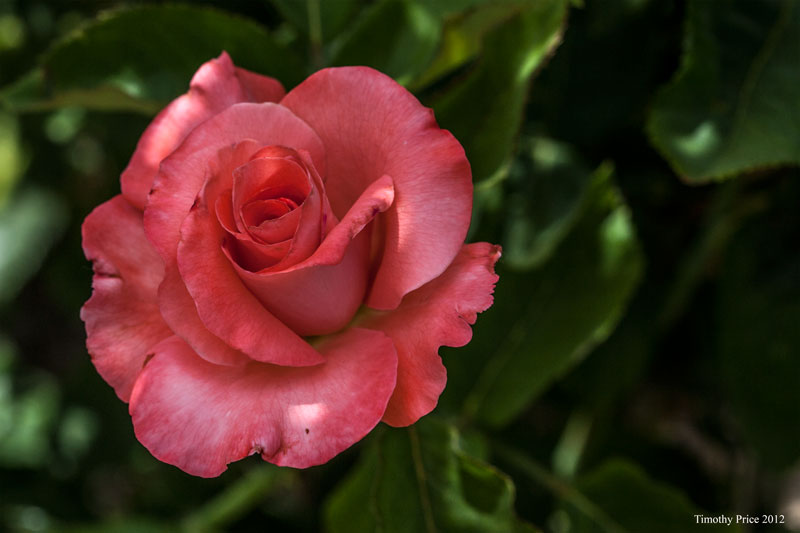
Mermaid is putting on some nice blooms. If you haven’t heard, the bosque is on fire in part of northern Corrales, but mostly burning on the east side of the river across from Corrales. There is lots of smoke.
Austrian copper put on a second bloom, which is really late and really out of the ordinary for Austrian Copper.
Sandias in B&W
I went for a walk in the bosque tonight and realized it was the first time I’d taken my new carry camera to the bosque, and this is the first photo of the Sandias from the edge of the river I’d done with the XPro-1. Photos of the Sandias from the river bank have been among the first photos taken with my other cameras. This photo is frame number 1021, so I’ve really neglected the Sandias and Rio Grande over the past few months.
My port cooperated and returned blood from each side when I went in for my monthly port flush this morning. I have a PET scan on Thursday and a doctor appointment next Tuesday, so if all is well, then maybe I can have the port removed.
Casita Sunset
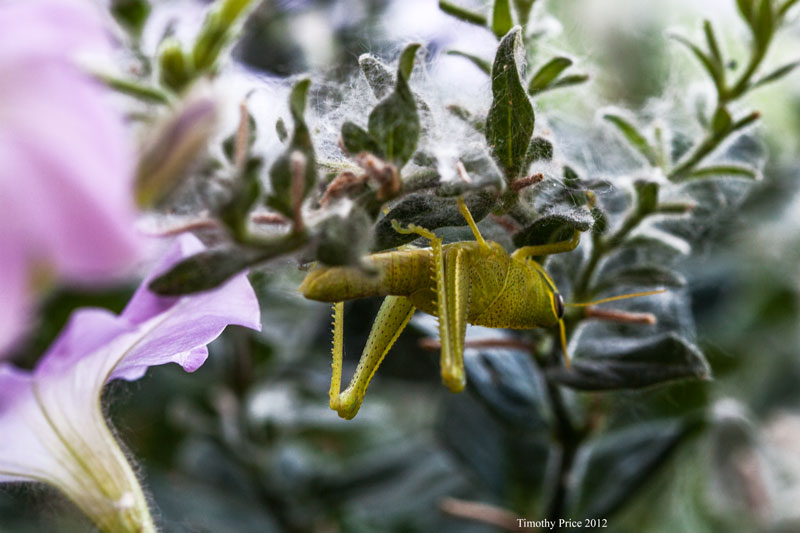
As I walked the property tonight looking to see if I could find any of the original survey stakes, the sun going down behind the casita created a nice lens flare. I noticed the bright orange lilies are blooming, and a green grasshopper was hanging around, upside-down on the the petunias. By the time I checked all four corners of the property, photographing various things along the way, then visited with our neighbor over the wall, it was 9:00 PM. Amazing how time goes by on summer evenings.
Hang Six
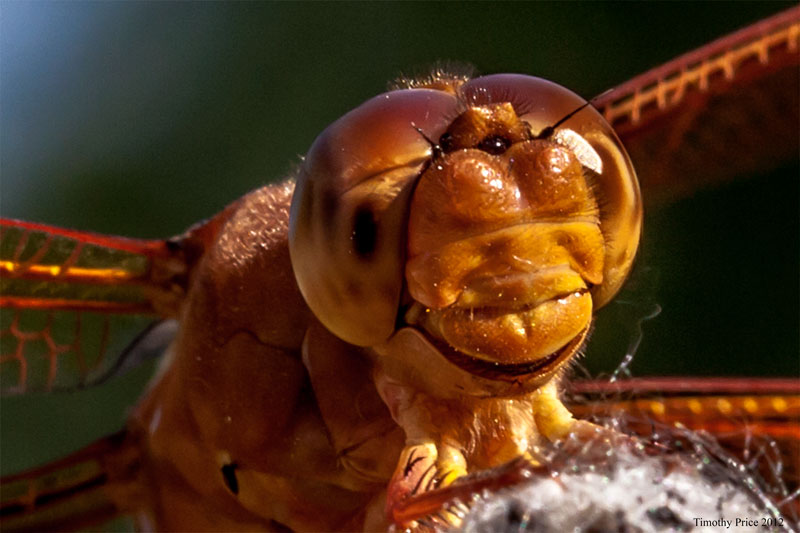
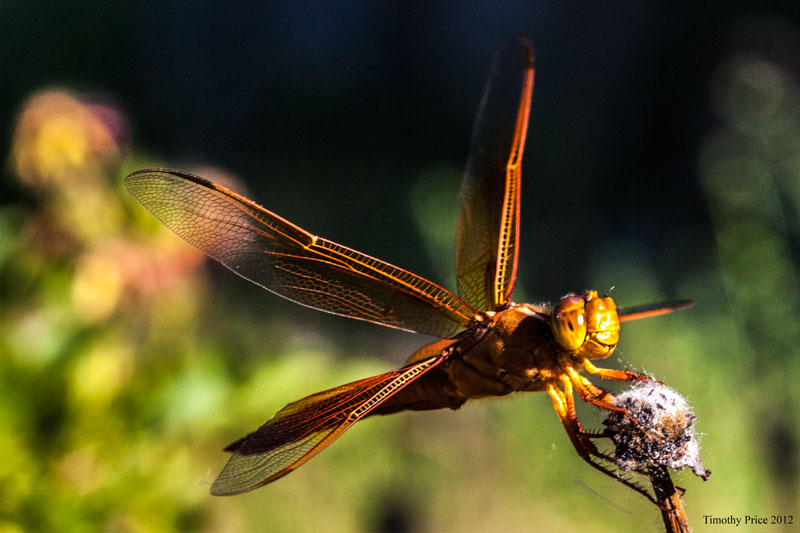
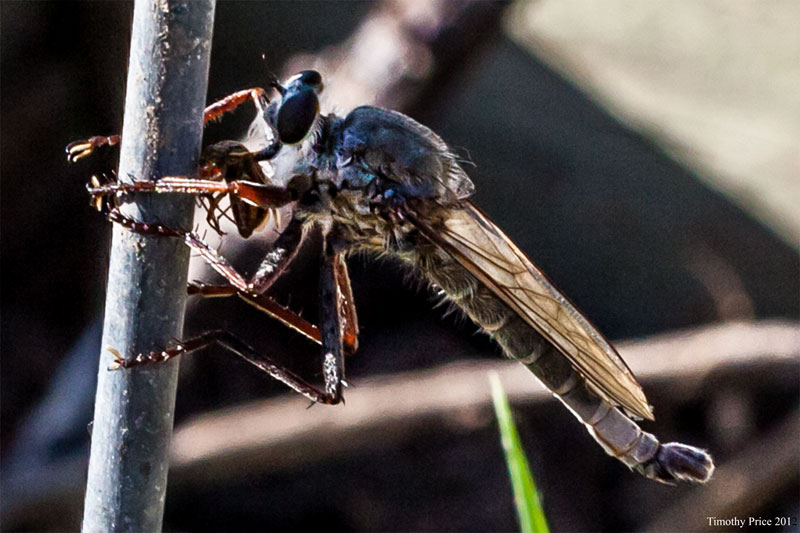
“Yee Ha! Hangin’ six! Let it blow! Let it blow!” is what I believe this dragonfly might have been saying as it windsurfed while holding on to a spent rosebud. That smile on its face was either equivalent to clinching its teeth while holding on for dear life, or it was simply having a great time being whipped around by the wind. The second photo is a Robber Fly with dinner. It had a nice profile in the low, afternoon sunlight. In the last photo, the dragonfly was so attached to the cotton covered rose hip it was hanging onto in the wind, that it let me get as close as my 100 mm macro lens would allow me to me to focus.
Tristan came out and cooked a great shrimp scampi for Father’s Day, and a friend who is in town came out a visited before she heads back to Chicago. Having shrimp scampi, german chocolate cake, coffee and visiting with Lynn was a very nice way to spend the afternoon on Father’s Day.
We put Stretch inside around 6:30 pm so he wouldn’t give us a hard time coming in later. Laurie was deadheading some of the rose bushes around the deck while I was working on photos. Stretch was meowing around in the catio, and about 7:00 pm he came strutting out from between a rose bush and the day lilies, just as bad, sassy and proud of himself as he could be. He sauntered up onto the deck, looked straight at me and meowed like “Here I am! So there!” I believe he paid to close attention to the movie the “Grand Illusion”, a 1936 classic about French officers who escaped from a German POW camp in WWI. They dug a tunnel in one POW camp, and Stretch took that to heart and tunneled out of the catio. I had to interrupt preparing photos for the blog to block up Stretch’s tunnel and cat proof it or at least make it harder for his next great escape.
A Small World
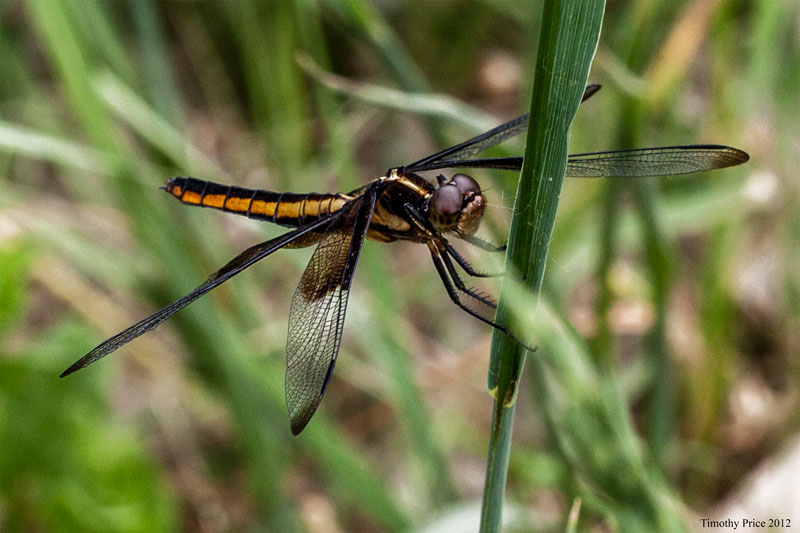
This tiny hovering bee was a difficult subject to capture. It’s so small that auto focus can’t see it, so I had to use manual focus, but while the bee does hover, it only stays in one spot for a second before it moves. I managed to get it in focus, and what’s even more interesting is that you can see my reflection in its shiny back. The crab spiders are no bigger than the tiny bee, but at least they held still. But my real prize for today is the black dragonfly. This dragonfly is like the “Night Fury” in “How to Train Your Dragon” as far as my auto focus is concerned — it detects something is there, but can’t see it well enough to focus. Auto-focus also has a hard time with black cats, but it’s a major fail on black dragonflies (Laurie thinks they should have a “black cat” mode on the camera). Therefore, I’ve had a hard time getting of photo of this dragonfly because when it hears the autofocus whirring back and forth it flies off. With my lens set on manual focus, I was able to sneak up on the black dragonfly and get it in focus, and in a decent position.
Sign of the Beast
Map Wars
A good lesson in how the free market works is the current map wars being waged largely between Google and Apple that has forced another heavy hitter to enter the free mapping API market — ESRI, who produces ARC GIS. What I find particularly interesting in this case is that ESRI has a monopoly on geographic information systems (GIS) mapping programs with all levels of government, and a huge part of the private sector market, as well. We have used ESRI GIS products since the early 1990’s. In 2004 when I began exploring GIS and mapping services on the Internet, the fledgling ESRI web mapping applications required purchasing the applications that we would run on our servers at a cost of $50,000 to $100,000. We developed our own web-based GIS instead using open source map servers, but map servers turned out to be very high maintenance and were always behind the server OS updates.
With more important work that needed to be done, our web-based GIS was out of service by 2006. We were still relying heavily on standard GIS mapping and employed ARC GIS techs in order to provide GIS and mapping services. In the meantime, Google had gotten into the mapping business in a big way — first with Google Maps and then Google Earth. As we began using those tools for more of our mapping needs, we quit relying as much on traditional GIS, especially ESRIs products. By the end of 2010 our last GIS tech left and we didn’t replace her, because there wasn’t enough demand for a GIS tech’s services anymore. We had other GIS programs, but most of our staff would simply use Google Maps and Google Earth for their base maps, and I started using Google’s application programming interface (API) to build custom maps on the Internet using our databases.
Here’s where it gets really interesting. When it came time to renew our annual service contract for our ARC GIS licenses last year, I opted not to renew them since we didn’t have a GIS tech anymore. ESRI really worked on me not to drop the service contracts, and wanted to know why I was not renewing them. I explained to the service rep that 1) we no longer employed GIS techs, and 2) we were moving our mapping to the web and using the free mapping API offered by Google. In a meeting yesterday, I was told that ESRI is offering mapping services similar to Google and Yahoo. When I had a free moment this afternoon, I went to ESRI’s website, and sure enough, they are now offering their web mapping API for free. I studied the API, got some of their sample code, and soon had a couple of applications on our server, and customized one to display some of the data from one of our databases — the New Mexico Facilities map below.
Eight years ago, ESRI wanted $50,000+ for me to create web maps using ARC GIS for the web. Back then those expensive apps could not produce maps as sophisticated as the one I created in a couple of hours this afternoon for free. What’s more surprising is that I had to set up a developer’s account with Google and OpenStreetMap in order to get access to their APIs and maps. So far I’ve adapted two web-apps using ESRI’s API and and maps, and haven’t had to set up an account or register the apps.
The free market has a powerful effect on prices and services, and while ESRI has a monopoly on traditional GIS, I believe they saw they were getting left behind in the web-mapping market and was forced to offer their API for free like Google, Yahoo and OpenStreetMap. Do you suppose other companies are not renewing their service contracts with ESRI?
Hollyhocks
We have some volunteer hollyhocks coming up against the adobe wall this year. We had hollyhocks in the area, but they hadn’t sprouted in the past 6 or 7 years. These must have come up from seeds that lay dormant for all those years. The kitties were hanging around in the garden with us tonight. Diné and Mama Manx really enjoy hanging around among the plants. Mermaid was full of blooms on Saturday, but when I checked on her this afternoon, she only had one bloom.