Where Did All The Water Go?

Heavy Metal song about the drought. The lyrics are at the end of the post.

In my last post I responded to comments about the Rio Grande running low that in the 60s, 70s into the early 80s, the Rio Grande would dry up in the summer months. The current headlines read “Rio Grande runs dry in Albuquerque for the first time in 40 years“. The water is running low, but it is still running through Corrales. Other people have asked when will the drought end? Based on historical trends, I’m guessing we will be under drought conditions for another seven years or longer. I put together the page below that shows historic trends in annual precipitation and the Palmer Drought Severity Index. Note the Storage levels in Elephant but follow the drought index. There was a very severe drought in the 1950s. We might reach that level of severity over the next several years. While the current conditions are alarming, they are not unprecedented. Another article you might be interested in is “5 droughts that changed human history” on the World Economic Forum website.

Climate is always changing, and those changes in warming and cooling and flooding and drought run in various cycles from a few years to thousands of years to tens of thousands of years. I remember a person mentioning to me that the goal of the current fight against climate change was to get the earth to have a constant temperature of 70º F (21º C). All I had to say is that if the climate warriors who apparently believe they have God-like powers actually reach that goal, the earth will be dead. I don’t know how common the idea that the war on climate change is to stop the climate from changing in an attempt to establish a constant temperature, but just that fact that someone actually believed it I found quite frightening.
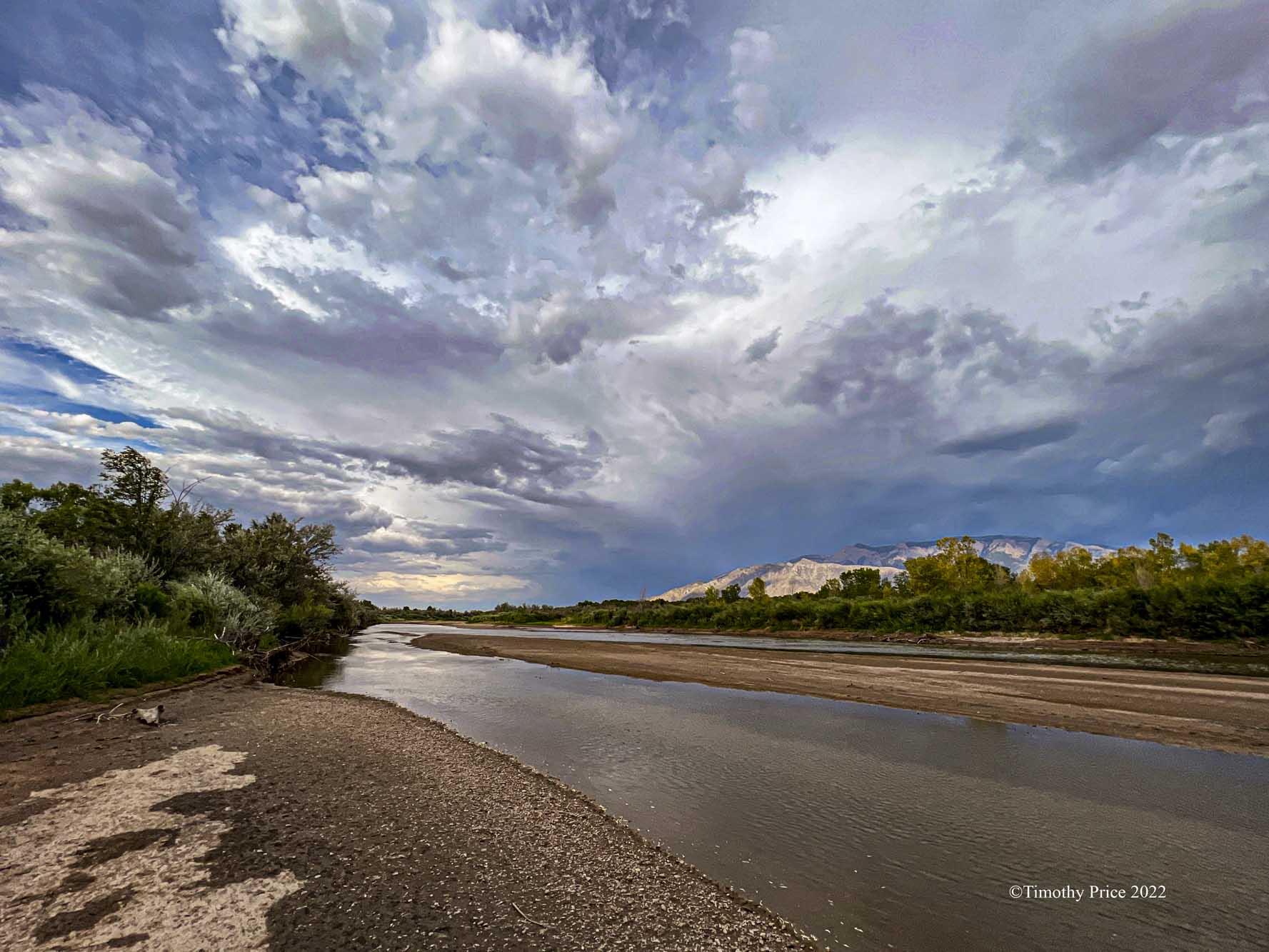
On the Rio Grande this afternoon looking north from Beaver Point.

On the Rio Grande this afternoon look south from Beaver Point.

Stormclouds all around

The Drought
By Timothy Price

Where did all the water go?

Scorched earth cracked white clay
Fried in dryness, woe
Drought sucks life’s blood away
Where did all the water go?

Where did all the water go?

Thirsty plants bow their heads
Pray for rain, the watershed
Parched seeds cry die of thirst
How have we earned this curse?

Sun shines happiness
We frolic in deceptive rays
Encourages us to foolish ways
Water’s precious, so we say
But we waste it anyway
In denial as it dwindles
Less and less from day to day to day

Where did all the water go?

Where once water flowed clear and cold
Green slime clings to mud
The water’s foul, so the waterfowl
Fly off in search of some

Where did all the water go?

Truth or Consequences

We met the tour van in Truth or Consequences, NM to take us to the Space Port yesterday. Truth or consequences, or T or C for short, is 150 miles south of Albuquerque, NM just off of I-25. Today it is probably best known for Elephant Butte Lake and State Park, but it also is known for its odorless hot springs, and before 1950 it was named Hot Springs, NM.  In 1950, Ralph Edwards, the host of the popular radio show that eventually became the popular television show Truth or Consequences, announced that he would air the show from any town that would change its name to Truth or Consequences. Hot Springs won the honor, officially changed its name, and Edwards visited the town for a fiesta every May for many years after that. T or C voted to keep the name in 1967, but there is new talk of changing the name back to Hot Springs since many people today do not associate it with the game show that went off the air in the late 1980’s.

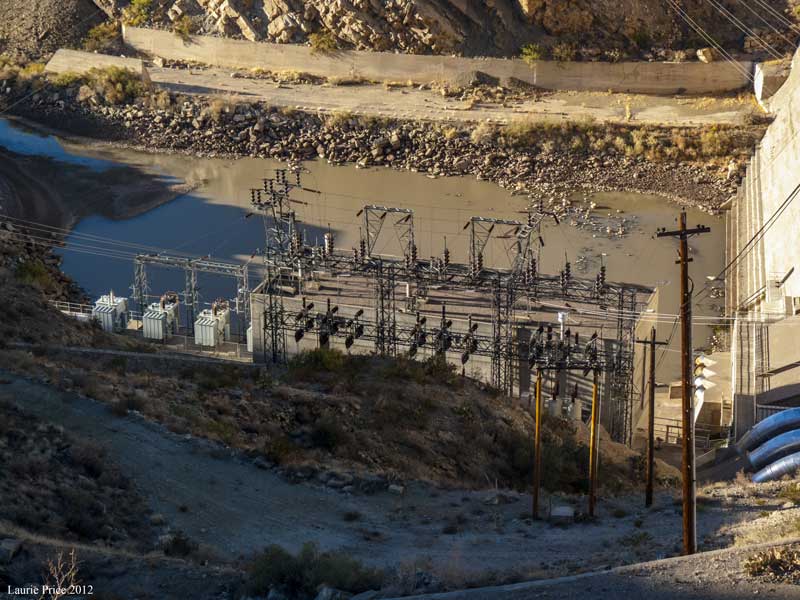
Another attraction in T or C is Elephant Butte Dam. Construction started in 1911 and the dam was completed in 1916 (20 years before Hoover Dam). The dam was a high tech engineering marvel of its day at 300 feet high, almost 1700 feet long and 228 feet wide at the base. The project made irrigation available to about 180,000 acres of farmland. There is also a 28,000 kilowatt  generating station at the base of the dam that was installed in the 1940’s; it currently generates enough power for about 20 homes.

Water has gone over the spillway twice in its 100 year history, and I got to pull a “you saw water going over the spillway when you were just 9 months old,” on my daughter yesterday. The 1980’s were a wet decade for NM, with 1986 was the high water mark for Elephant Butte. I raced the first Tour of the Gila bicycle race in Silver City, NM at the end of May 1987, and we stopped to see the water running over the spillway on the way home from the race. Of course Tristan didn’t remember, but I got a certain satisfaction out of telling her she saw it, because my parents did that to me all the time — “Oh yeah you were there with us when you were 2 years old!” they would tell me. Thanks! Like I remember places we visited when I was two. Fortunately for Tristan, we didn’t take her to very many places worth remembering until she was old enough to remember them, however, the historic water going over the spillway at Elephant Butte Dam happened to be an exception.

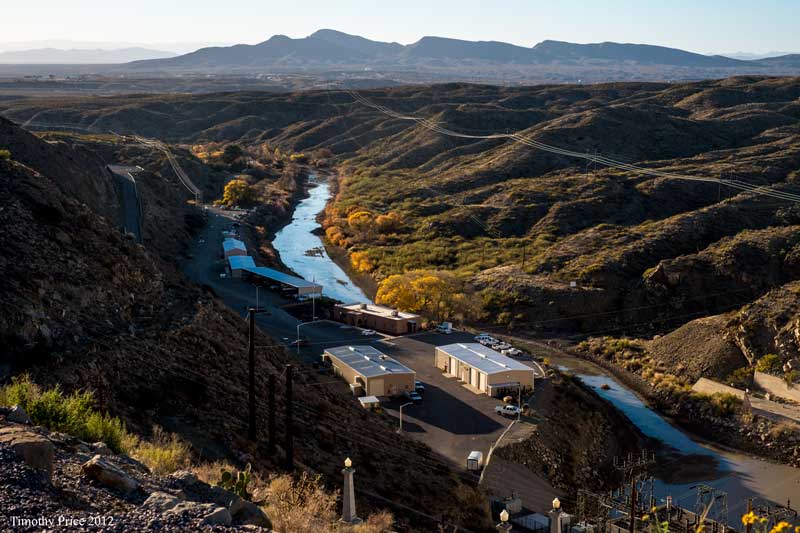
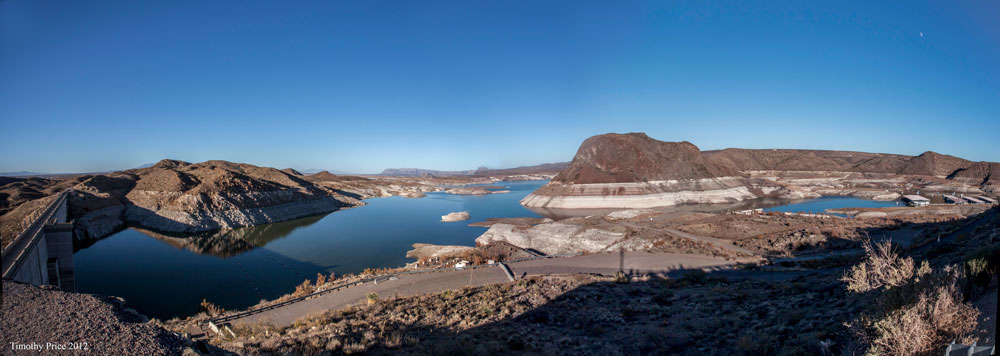
As you can see from the photos, the lake is very low right now. New Mexico is a high, arid desert and wet decades like the 1980’s are not normal. So what people have been calling a drought for the past 20 years or so, is really more normal for New Mexico; although the past few years have been very dry, so the cycle has probably swung to the opposite extreme from the wet period we had in the 1980s. The peaks between very wet periods and really dry periods for New Mexico seem to run in 50 to 60 year cycles based on the NOAA weather data we got when we had a NOAA weather station on the property.

Looking southwest above the dam. The Rio Grande and distant mountains.

Project buildings along the Rio Grande below the dam

The power station at the base of the dam

Panoramic view of the dam and lake. The large island or “Butte” near the center of the photo is thought to look like an elephant