Here are a few more photos from our trip to and from T or C last Friday. The flags were at a rest stop on I-25, and I took the sunset and view through the windshield of our Mazda Speed 3 from the back seat. We decided it was safer for Laurie to drive until dark, otherwise, I would have probably taken some of these photos while I was driving.
Does anyone remember the Lone Ranger? For some reason this couple reminded me of the show. The sun had set when I did the first two photos, so the light, softness, and color from the slow exposure and wide-open aperture gave the photos a real western movie look. The photo of the cyclists were taken after sunset as well, but I added effects to that photo. An old car pulled up next to me at the light while I was on may way to Lowe’s and when I pulled out of the carwash, I got mooned by a droopy-pants’d kid working on his car. All together, I ended up with a somewhat disparate, short history of transportation in the photo series.
One the subject of droopy-pants, I cannot comprehend why young people want to wear their pants below the butt-lines, half falling off — other than to bother people. When I was in my early teens, I was 6’2″ tall, had a 26″ waist and a 36″ inseam. It was impossible to get pants that fit, so I either had to be 40 years ahead of my time wearing pants that were falling down all the time and getting called names like “baggy butt” and “saggy pants.” Or be 40 years ahead of my time wear pants that fit my waist but were way too short in the legs — I got teased for wearing “high waters”, “expecting a flood”, etc. for the long shorts. If I had been as far-sighted as my legs were long back then, I would have copyrighted and patented both the baggy pants and shorts that ended mid-calf. But who would have thought in the late 60’s and early 70’s that such uncomfortable, awkward and stupid looking clothes would become all the rage? We had Star Trek and the Jetsons showing us fashions of the future, and none of it rode below their butt-lines.
Spaceport Entrance looking east. White Sands Missile Range is on the other side of the mountains in the background
Laurie, Tristan and I went on a tour of Spaceport America today. Spaceport America is currently the only spaceport in the world built for the purpose of accommodating commercial spaceflights. The Spaceport is built in south central New Mexico, literally in the middle of nowhere, on 18,000 acres of public trust land surrounded by 350,000 acres of an old Spanish land grant now owned by Ted Turner, and the White Sands Missile Range on the other side of the mountains to the east. This location is ideal for a spaceport because of 1) low population — the only inhabitants in pretty much 50 miles any direction are a few ranchers, cattle, buffalo, coyotes, roadrunners, jackrabbits, birds and rattlesnakes. 2) White Sands Missile Range, which has a large restricted air space that commercial aircraft cannot fly through, and has a large “shadow” to the east and west since commercial flights have to make trajectories around the White Sand’s air space. 3) high altitude — Spaceport America is over 4600 feet above sea level; therefore larger payloads can be launched using the same amount of fuel that it takes to launch from sea level.
The Spaceport is not officially open, but they do currently have vertical launches. We did go into the Control Center building which is a concrete dome with ceramic tiles on the outside. To construct the Control Center, they poured concrete over a large balloon and then cut out the openings. The second floor is hung from the dome and has no vertical supports from the floor on the inside of the dome. The viewing area of the Control Center is in the “Eye” that pops up from the dome facing the runway.
The tour van drove us to one end of the runway, and I included a photo Laurie took of me photographing the number, 16, and the orange “X” that is held down by rocks on the end of the runway. The runway is currently 10,000 feet long, 200 feet wide and 43″ thick. The Spaceport Authority is extending the runway by another 2,000 feet so a spacecraft with a full rocket can land safely (if the rocket can’t fire it’s rockets and has to land, it has to land with the extra weight of full rockets).
The Terminal Building with the hangers is not open to tourists, so we only got to see and photograph the outside of the building. One of the design criteria of the buildings at Spaceport America is that they have to blend into the environment. The building is very organic without a straight line on the outside. When you are standing on the end of the taxiway, where it intersects the runway, the Terminal Building roof lines up with the mountains in the background, and continues an undulating roofline from one side to the other. The Spaceport buildings where designed by a team of US and British designers and architects URS/Foster + Partners to the world.
East side of Control Center front view of “The Eye”
Office space inside Control Center
The Control Room
Spaceport Terminal Building from “The Eye” of the Control Center
The Control Center with a profile of “The Eye”
Me photographing the 10,000 foot runway
View of how the spaceport Terminal Building was designed to match the mountains in the background
The Virgin Galactic Taxiway
Spaceport Terminal Building glass front viewing area
Spaceport Terminal Building glass front and south hanger doors
Spaceport Terminal Building south facing hanger doors
Only seventeen days left until the Central United Methodist Chancel Choir with the New Mexico Philharmonic Orchestra present Handel’s Messiah. I am listening to the choir rehearse as I write, and they sound wonderful. Besides singing, the choir director has the choir do choral calisthenics and stretches so they will be in ship shape to deliver outstanding performances. The performances will be on Saturday, December 8th at 7:00 pm and Sunday, December 9th at 3:00 pm. If you live in the greater Albuquerque area, I highly recommend getting tickets to this concert. Tickets can be purchased on-line at http://holdmyticket.com/event/119812.
Handel composed the Messiah in 1741, a 100 years before the term photography was attributed to the process of recording images on a medium using a camera. Since the daguerreotype was one of the earliest photographic processes that resulted in a direct positive, I used a hand-colored daguerreotype effect on the photos of the choir doing their calisthenics, stretches and singing to represent an early time. It doesn’t take us back to the time when Handel lived, but it does give a sense of rehearsing the Messiah in the earliest days of photography.
My new 17-40mm ƒ/4 ultra-wide angle zoom lens was delivered this afternoon, so I tried it out downtown (and on the rib roast I picked up on the way home tonight — we are having standing rib roast instead of turkey for Thanksgiving). The lens is sharp and has good edge to edge detail, even wide open at slow shutter speeds. The photo of Liz in Patrician Designs was shot at 17mm, ƒ/4 at 1/20 sec at ISO 100. Liz is a little soft because she was laughing, but the sharpness and depth-of-field is impressive. I bumped up the ISO to 400 when I photographed Megumi in Cafe Giuseppe (1/30 at ƒ/4). I photographed the mutual life building at ƒ/11 and One Up at ƒ/7.1. The rib roast was a little more work. I used two flashes, one on the camera, the other in my hand. At 17mm, I was about 3 inches from the roast, so I had to use manual focus, hold the camera with one hand, while aiming the flash with the other (I was too lazy to get out a tripod, which would have made doing the photo much easier). The exposure was 1/160 at ƒ/5.6 ISO 400.
These trees on the north side of Castetter Hall at UNM are nicely shaped and cast wonderful shadows under the night lights. Rosencrantz and Mama Manx were snuggled together on the couch, but the minute I pointed the camera at them, they looked up at me. The clouds were beautiful on the Sandias this morning. Laurie had an appointment at school, so we didn’t have time to make a short detour to the open space across from the Balloon Museum and get a better view of the Sandias without so many buildings and power poles.
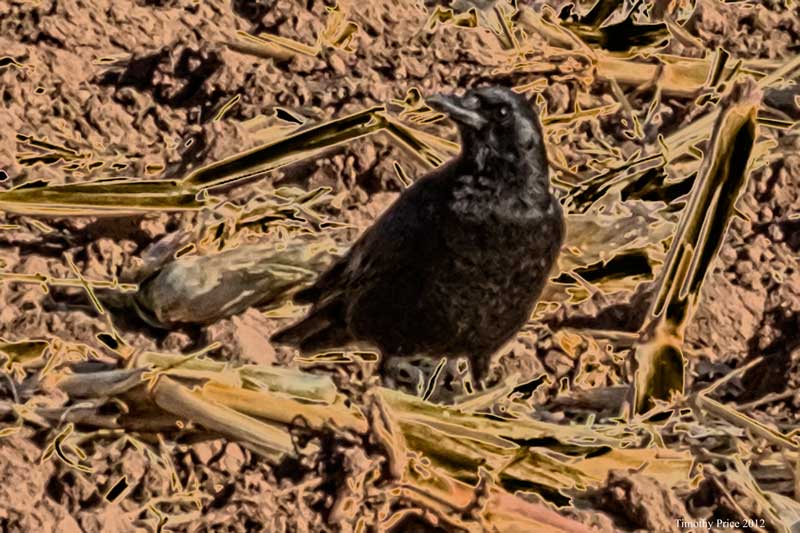
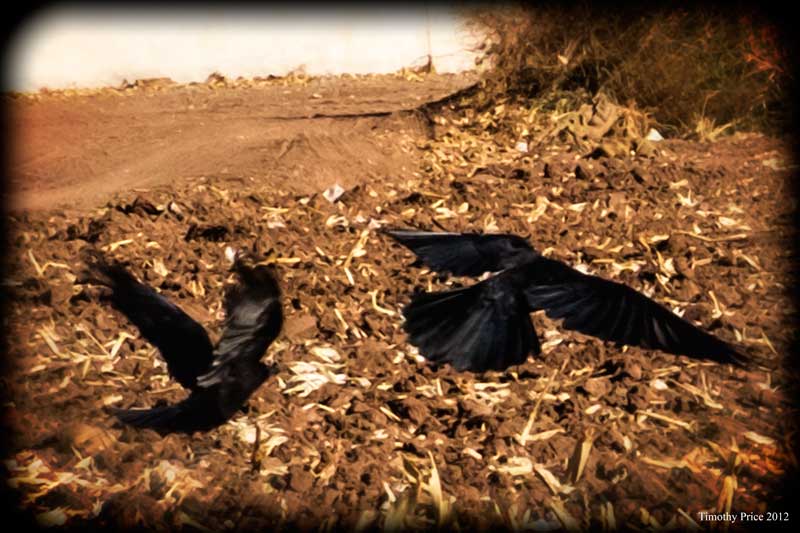
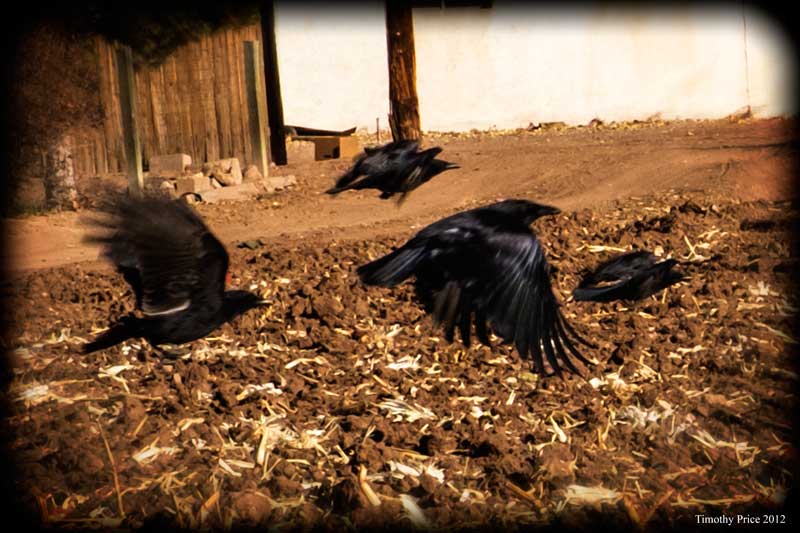
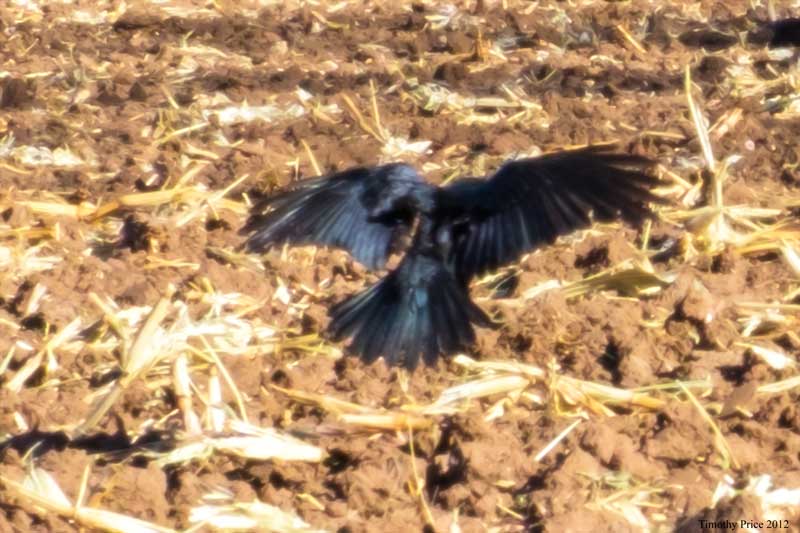
Wagner plowed the corn field under. The cranes are sparse so far, and there were a few geese, but the crows are really taking advantage of the corn scattered by the plowing.
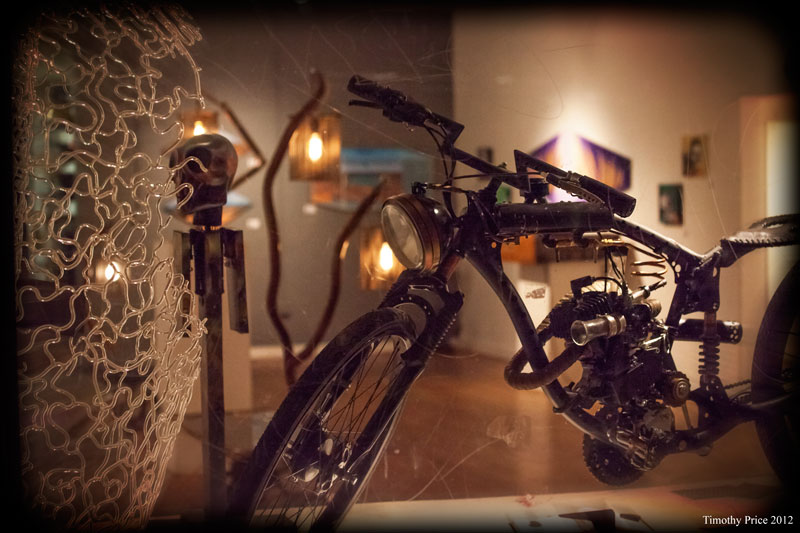
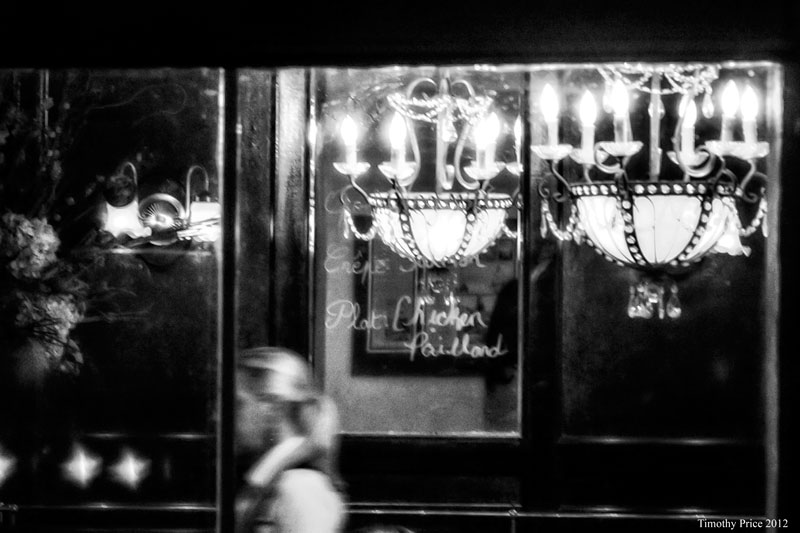
I walked around downtown after work tonight and found some interesting windows. The motorbike in an art gallery’s window looked like it might even run — could be functional art. Functional or not, it is an interesting piece.
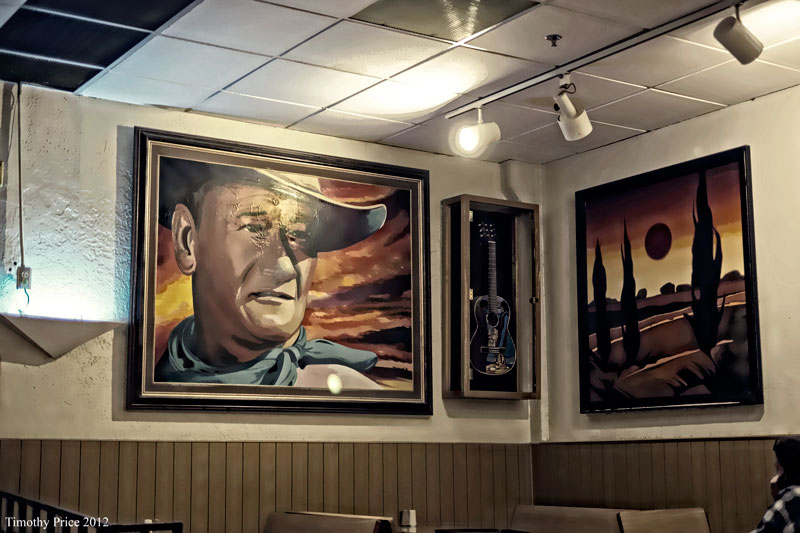
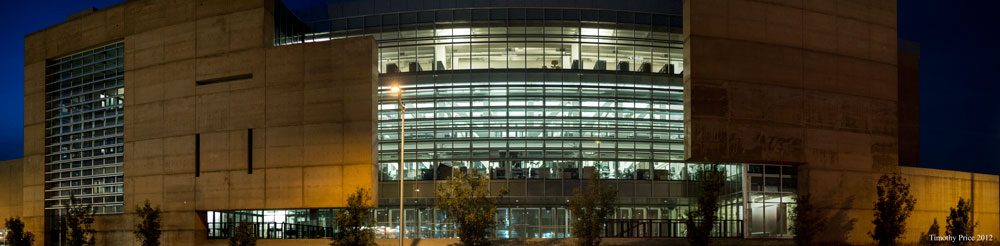
When you think of icons and landmarks you can’t get much better than the painting of the Duke in the Frontier Restaurant across from UNM’s new School of Architecture Building on Route 66 in the Duke City. John Wayne stares, from his large portrait hanging on a south wall in the Frontier, straight out north windows at the new Architecture building across Central Ave (Old Route 66). While I was waiting to cross Central on my way to the Frontier, I heard engines roaring and tires squealing and zoomed my lens toward Girard to capture either a car chase or car race on Old Route 66. One of my clients thinks I need to make another edition of my photo book Route 66 Albuquerque’s Central Avenue After Dark and include images like these. He thinks the book is incomplete without a photo of the painting of the Duke in the Frontier and a photo of the School of Architecture Building at night.
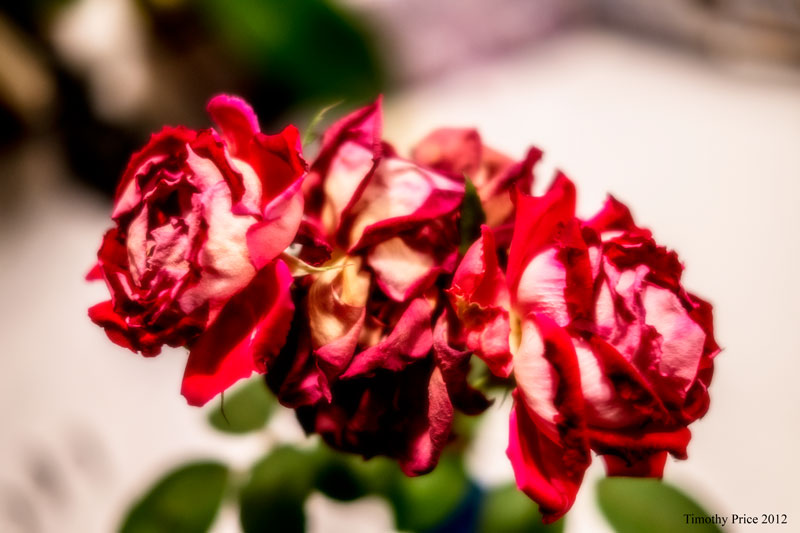
It was a “real” Monday Monday. First of all, my weather widget on my computer said the low in Corrales would be 25 F, so I figured 15 F or so. When I got up the thermometer on the fence showed 5 F, which means it was near zero in other parts of the garden. The roses and flowers that were holding up against lows in the high teens and low twenties under the protection of the canopy are now freeze-dried, and my water filter, which I forgot to disconnect, was busted into pieces by the hard freeze. The weather widget says the low tonight will be 29 F — Ha! Ha! Ha! Ha! Ha! The temperature is already down to 20 F. We are definitely doing our part to fight global warming.
But the Monday Monday didn’t stop at near zero temperatures. After I got the work one of the modules in the phone system went on the blitz, I had to restart a server and it didn’t want to reboot, clients upgraded their computers and their browsers were not reading javascript properly, so our web apps were acting up — just one thing after another.
Although one bright spot for a Monday is our Christmas Cactus bloomed (3rd photo). I think this is the sixth year in a row that it has bloomed for us.









 Off Center & Not Even