Imperial Building 01/22/2016. I put together an improved animated gif of the building going up over the past year, and replaced the gif I put up on January 13, 2016. Click on the photo to see the new animated gif.
It’s not the first time I’ve been banned for life because of my photographic endeavors, but yesterday’s ban was more surprising than when I was banned for life for photographing the Sandias from the edge of an Indian Pueblo. While the Pueblo’s police officer did not argue the fact that I was not on pueblo land, he had a problem with me photographing the Sandias, which he said is sacred property that belonged to the Pueblo. So he wrote me up for photographing the Sandias from the edge of the pueblo, and told me I was banned from the pueblo for life.
As anyone who has followed my blogs for awhile knows that I have been documenting the construction of the Imperial Building going up behind our office over the past year from the parking garage on 2nd Street. While city security staff has seen me on the garage taking photos of the construction many times over the past year, none of them have ever taken any notice, and said nothing more to me than “Hi!” when we were in earshot of each other. Yesterday, however, a security officer drove up and told me that I was not supposed to be on the parking structure, ordered me to leave, and told me to never come back. I asked her about people who parked in the garage, and she said anyone parking in the garage is supposed to walk to and from their cars, and are not allowed to walk anywhere else in the parking garage. Okay! I left, and shook the dust of my shoes as I walked out of the garage.
I understand that the City doesn’t want people wondering around in the parking garage breaking into cars, but I’m obviously not breaking into cars. Since the Imperial Building is almost done, it probably doesn’t really matter if I don’t do anymore photos of it from the parking garage, but I would like to finish the project from the same vantage points. I emailed Mayor Berry and asked if his office would give me a letter granting me access to the parking garage so I can finish documenting the Imperial Building to its completion.
I also went back through my photo archives and created a new animated gif of the construction over the past year. I had missed a couple of weeks of progress, which I overlooked trying to get the first gif completed so I could post the gif on the one year anniversary of ground breaking on the project. So the new animated gif is more complete and all the images fit better than the first animated gif. You can see the new gif on the post from January 13, 2016 at https://photoofthedayetc.wordpress.com/2016/01/13/the-ends-in-sight-a-year-after-a-ground-breaking-experience/
†Image from Bestiary MS Bodley 764. Page 43. “Bestiary being an English version of the Bodleian Library, Oxford M.S. Bodley 764 with all the original miniatures reproduced in Facsimile. Translated and introduced by Richard Barber. The Boydell Press. Woodrifge. 1999”
Parks and Open Space
Madrid is really great about parks, playgrounds and open space in among the dense urban environment. Almost every plaza has a park with benches and a playground. The Spanish haven’t decided that swings, slides and monkey bars are unimaginative, or too dangerous. They have play equipment that was outlawed in the States years ago. The kids love the play equipment and the playgrounds. The playgrounds are always full of kids playing, families hanging out and people walking dogs basically all day. You see more families starting about 6:00 pm on until 10:00 pm or later. During the day you see groups of kids on recess, adults swinging and walking their dogs, and moms with younger kids in the playgrounds. People tend to really use public areas. You do a lot of living and playing in the city streets, parks and cafe bars, as opposed to sitting at home and watching television (although, I think a lot of people sit at home and watch TV also).
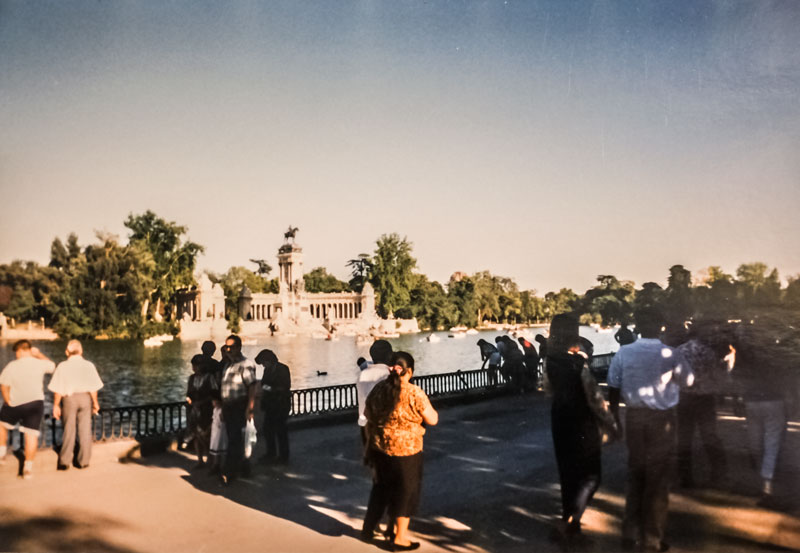
Estanque del Retiro. The main water feature in Parque del Retiro.
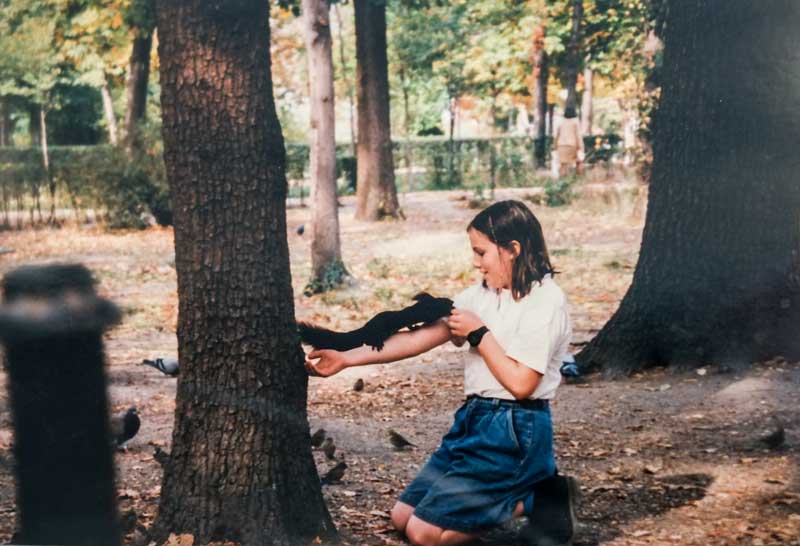
The Parque de Retiro is on the eastern side of the centro. This is a large park with all kinds of stuff: trees, well kept gardens, pathways for walking and running, streams, fountains, sculpture, lakes, a crystal palace, birds, ducks, swans, geese, extremely tame squirrels, cafe bars and sports facilities. You can rent boats to row on the larger lake and there are paved streets used for skating, cycling, and roller blading. We spend quite a bit of time in Retiro. It is a very nice park to hang out and relax in. I walk 10 kilometers every morning, and the majority of the walk is in Retiro.
Tristan playing with a squirrel in Parque del Retiro.
Another beautiful park is Parque de Oeste. Oeste is 3 kms. west of us on the edge of the Rio Manzanares valley. Oeste is much more wild than Retiro, It has relatively steep slopes and many hills covered with grass, a large variety of trees and wild shrubs. There are pathways winding up, down and over the hills, and monuments dispersed among the foliage. You feel like you are in the mountains. There are information placards the describe many of the trees and bushes, their history, usage, and origins.
Rose garden in Parque de Oeste.
Just across the river, west of the centro, is a huge open space called Casa de Campo. This is were you train if you ride a road bike, plus it also has really good mountain bike trails. The area is very hilly and covered with pine trees. There is a long (2.5 kms) aerial tram (Teleferico) that runs from Parque de Osete on the east side of the river to about a third the way into Casa de Campo. The Teleferico is reasonably priced and really fun to ride. It gives you a great view of Madrid, the Guadarama mountains, and Casa de Campo. From the looks of the place, it is set up to handle a lot of people picnicking, camping, playing, hiking, biking and going to the zoo and the amusement park located along the south side of the park. We walked up to the zoo once, but it cost 1500 ptas per person to go in. We said no thanks; however, we have been assured by the natives that the zoo/aquarium are well worth the price. There are playgrounds, soccer fields, trails, picnic tables, campsites, and a lot of trash cans. I’ll bet the park will have a million or so people at any given time in the summer. We’ll have to see.
The one curious thing we noticed about Casa de Campo as we were walking from the eastern end of the park up to the zoo, were prostitutes on every intersection and along the roadways in that end of the park. I started referring to them as PnP (putas in the park). The first one I noticed was an attractive Spanish woman standing along the road under her umbrella (it was a rainy day). As we headed west, the number of prostitutes increased and they were primarily black women (African). We were in the park during siesta, so I’m guessing that men take their siesta time to go out to Casa de Campo to hire a hooker, go off in the bushes, or park in a remote area, have some whoopee, and then go back to work. It is really strange to see prostitutes advertising themselves in a wooded open space. The only other place we have seen prostitutes, on a regular basis in Madrid, is at Gran Via and Calle Hortaleza. We joke about Gran Via at Hortaleza not being a good spot for a rendezvous. I use to think that tourists who can’t or don’t read local papers were the main client’s of these horrid looking, unhealthy, obviously drugged out street creatures; however, I have seen several men who were older, not very good looking and often handicapped (with a lame arm or leg) making deals with these ladies. I have to pass by there quite often to get to may guitar lessons and into the centro, and you can’t help noticing what’s going on. Prostitution is apparently legal here. When I was looking for apartments in the classified section of the paper, the largest section in the classified’s was for prostitutes of all types: male, female, young, old, all nationalities. They even had classified’s advertising non-professional hookers.
Retiro and Casa de Campo are the two main parks we have been to. The map shows many other large parks, hundreds of small parks, and a large area to the northwest that looks like the equivalent to a national forest in the U.S. We are scouting out horse lessons for Tristan, and that will take us to mountains around Madrid.
Another interesting space in Madrid is the Atocha train station. There is an indoor rain forest at the train station where you can go and hang out. It is very pleasant, the air is clean, and the trees and plants are large, thick and healthy. There are benches all over the area were you can sit and read, think or just watch people. There is a lily pond with gold fish and turtles that keeps Tristan entertained. There is a cafe bar, a few shops, travel agencies, and a car dealer in the rain forest. The car dealer only has two cars on display at any time inside and there are usually two to four very attractive sales ladies wearing short yellow skirts with matching blazers, black tights, and white blouses showing off the cars and answering questions. When we are making calls from the phone place off Calle de Atocha, or doing other business along Calle de Atocha or Paseo del Prado, we will walk over and use the restrooms in the train station and sit in the rain forest and relax a bit.
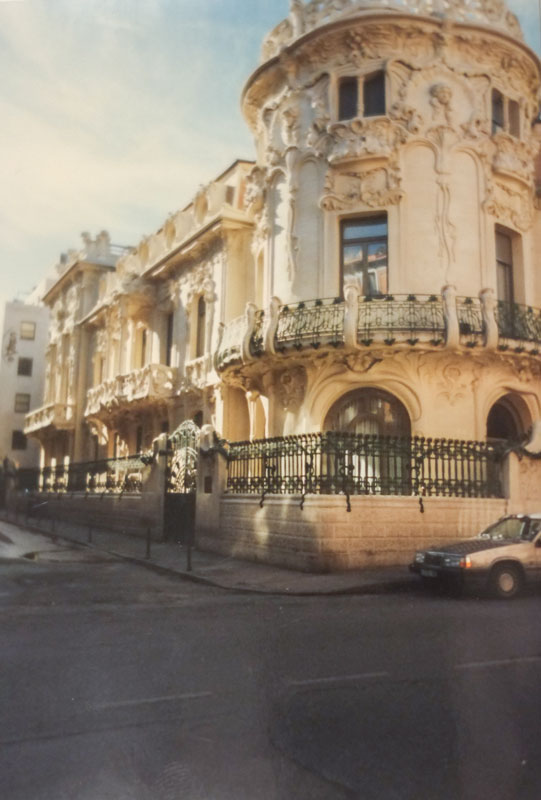
Sociedad General de Autores y Editores (S.G.A.E.) Building
After my first impressions of the museums, I turned to my initial impressions of architecture and planning. As you will see, the large round abouts where one feature we never had to deal with in Albuquerque and made an impression on me the first three months we were in Madrid.
April 18, 1996
Architecture and Planning
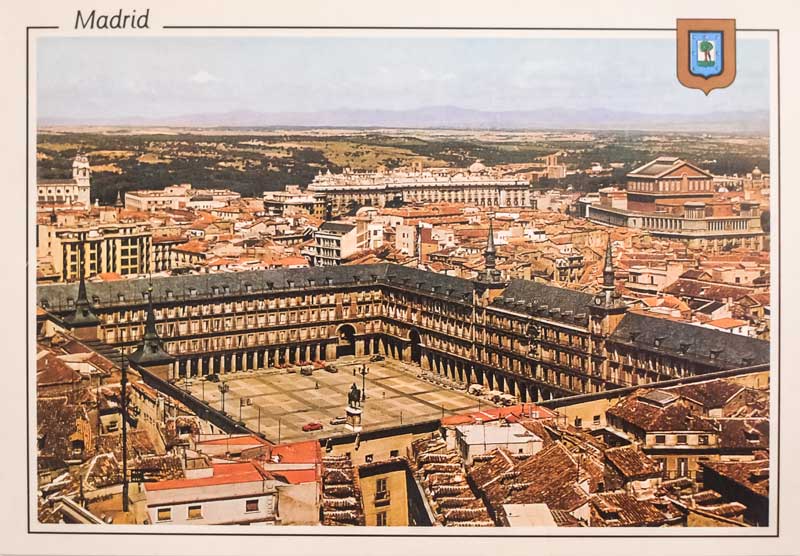
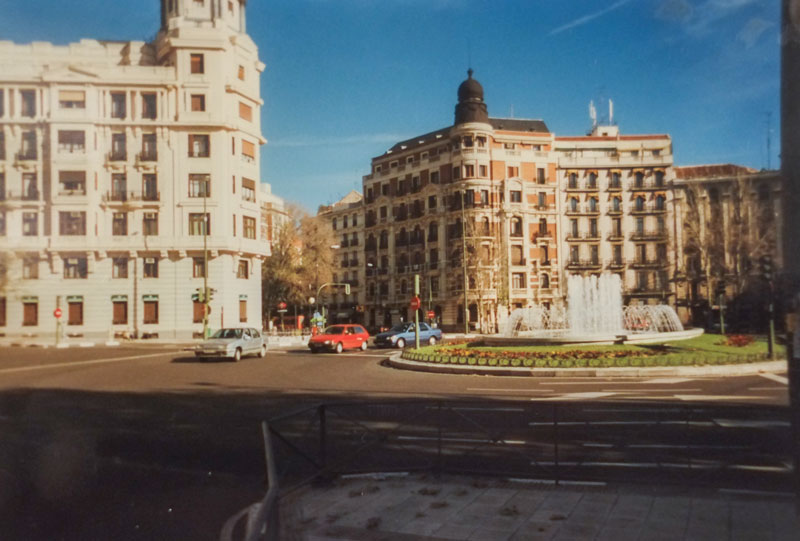
Architecture and planning is quite interesting in Madrid. In the middle of the centro, where we were in a pension for two weeks, the buildings are old, streets generally narrow and winding, making a quasi radial pattern resembling a messy spider web starting or ending at the Plaza Mayor. As you head any direction from the centro, you start getting a mix of old and new buildings, wider streets, and somewhat less winding and twisting roads. Of course, they have those stupid round abouts everywhere, which to cross them makes you really go “round about”. You will be walking a long a beautifully landscaped median, in the middle of a large boulevard, that has pathways, sculptures, flowers, birds, cafe bars and playgrounds, and then you come upon the round about. These things are huge, with beautiful fountains, gardens, sculptures or memorials in the center and, perhaps, a half a dozen or more streets intersecting them from all different directions. To get across these things you have to either go around them or, in some cases, under them (Anyone would be an absolute fool to try and walk across even a small round about in Madrid. Traffic is fast and does not stop for pedestrians unless there is a red light). Timing the lights at these things must be a nightmare,. I don’t think they have quite figured it out yet either (judging from the number of police officers directing traffic at the rush hours). You have to cross a lot of streets to get around the round about and continue on your way. Traffic will have a red light at the street your are crossing, but the crosswalk will still have a red light for a long time, because of all the traffic turning off the circle. Across the median there will be a green walk sign, but you still have a red. Your walk finally turns green, the one across the median is flashing green, meaning its about to turn red. If the street is less than 3 lanes you might make a run for it, if it is any larger you don’t. Once traffic gets a green light in Madrid, they are off like Indy cars. All vehicles around here have amazing acceleration. Back to the layout. The suburbs have taller buildings, more of a grid street pattern, and the farther you go out from the centro the more rows and rows of high rise apartment buildings you see.
Round about with a more modern fountain in the center
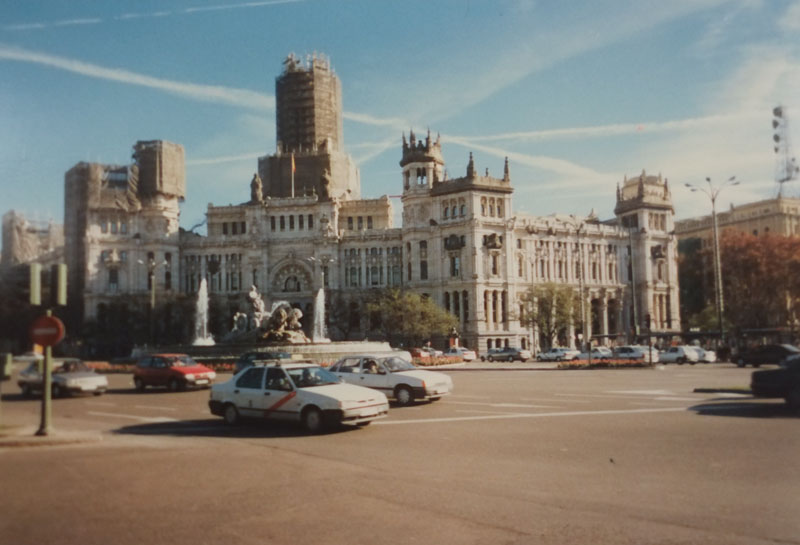
There is a lot of construction and renovation going on all over Madrid. In the centro buildings seem to have 3 obvious states of renovation before demolition and replacement. The first is the structural elements of the building are sound and the interior and general exterior are in reasonable condition, but the spires, cornices and other ornate features around the roof, doors and windows need work. You will see whole tops of buildings covered with nets to keep pieces of ornateness from falling to the street as the building is worked on. The second phase, which you see a lot of, is the exterior and facade are in reasonable condition, but the entire interior is gutted as they remodel it. The third level is stripping the interior and exterior down to the superstructure and rebuilding. And, of course, if the building is in bad enough shape they raze it and leave an empty space between the buildings on either side until they rebuild.
Palacia de Comunicaciones also called Palacio de Cibeles. The Cibeles Fountain in is the center of the round about for Paseo del Prado and Paseo de la Castellana.
The resulting architecture varies greatly depending on the level of remodeling. It seems that in the centro they try to just do interior remodeling, and preserve the original facade as best they can. I don’t know if they have historic district ordinances or not, but the architecture that completely replaces buildings in the centro fit in pretty well. As you get away from the centro the newer buildings often stand in great contrast to the older buildings on either side. What would be a decent building on its own looks ugly and out of place amid the old ornate buildings in the block. Sometimes the modern mixed with the old is quite handsome and works well. For instance, on Gran Via, a major street in the centro that is lined with absolutely beautiful, ornate buildings, there is a modern all black glass building stuck between two really pretty buildings, obviously replacing a building that had to be torn down. As you walk towards the building you think how odd, but then once you are right in front of it you realize all that black glass is reflecting the image of a stunningly beautiful old building across the street. It is a very nice effect to have the image of the building on the side of the street you are on reflected between the other two beautiful buildings across the street from you. I assumed this was planned, if not it’s a great coincident.





 Off Center & Not Even